Renew TIE After 5 Years: The Complete Guide in 2026
Renew TIE After 5 Years: Summary
- 🪪 The Result: Your temporary card becomes a permanent one: 10 years under the Withdrawal Agreement, 5 years for a first long-term residence card.
- 📅 When to Apply: In the month before expiry (Withdrawal Agreement) or the two months before (general regime), or up to 3 months after. Many police stations only take it once the card has expired.
- 📁 Key Forms: EX-23 (Withdrawal Agreement) or EX-11 with Tasa 790-052 (€21.87) and then EX-17 (general regime). Card fee: Tasa 790-012 (€12 or €21.87), passport & photo.
- ⏱️ Timeline: 30 to 45 days after your fingerprint appointment (Toma de huellas).
⚠️ Crucial Rule: Long absences can cost you the upgrade. In the general regime, no single absence over 6 months and no more than 10 months in total across the 5 years.
👉 Don't want to risk delays? Let our lawyers handle it- ⛔ Temporary TIE vs Permanent TIE: The Legal Reality
- 🔥 When You Can Actually File (And Why Police Stations Push Back)
- 🔥 Documents You Must Bring
- ⚖️ EX-23 or EX-17: Choosing the Right Form
- ⛔ Field 4.2 of the EX-23: The Question Everyone Gets Stuck On
- 🎧 Step by Step: From Fee Payment to Card Collection
- ⚖️ Absences Abroad: The Hidden Reason Renewals Get Denied
- 🏆 The "Group 2" British Citizens: Why They Are Being Refused
- 🥇 Denied at the Comisaría? How to Appeal
- 🌟 Can Any Part of This Be Done Online in 2026?
- ✅ When MySpainVisa Can Save You Months of Paperwork
- 💻 FAQs About Renewing Your TIE Card After 5 Years in Spain
- ☎️ About this guide for TIE Card after 5 years in Spain
If you need to renew TIE after 5 years in Spain, you should know that renewing the TIE at this stage is not, strictly speaking, a simple renewal. What you are doing is upgrading a temporary residence card into a permanent one, and the rules depend on which card you hold. For British nationals covered by the EU-UK Withdrawal Agreement, the right comes from Article 15 of that treaty and the card from Article 18.4, applied in Spain through the joint instruction of 2 July 2020: the five-year temporary card is replaced by a ten-year permanent one. For everyone else, the legal figure is Residencia de Larga Duración (Article 32 of Ley Orgánica 4/2000 and articles 175 to 185 of the Reglamento de Extranjería, Royal Decree 1155/2024, which replaced RD 557/2011 in May 2025). The two routes have different deadlines, forms and absence rules, and this guide flags which one each point belongs to.
Our firm has run hundreds of these procedures since the post-Brexit TIE was first issued in July 2020. This article is the version of the conversation we have with every new client who walks in with an expiring card: what the law says, what actually happens at the police station, where the process breaks, and when you can handle it yourself versus when you should not even try.
Need help renewing your TIE? Talk to our immigration lawyers today
Struggling to get an appointment? The hardest part of the whole procedure is the cita previa itself. We explain how the system works, why the slots vanish, and what actually helps, in our guide to the TIE appointment in Spain.
Temporary TIE vs Permanent TIE: The Legal Reality
Most expats assume the card works like a driving licence: reach the expiry date, book an appointment, get a new one. That is not quite what happens. The five-year card you hold is a temporary residence authorisation. What you are applying for now is a new, stronger legal status. The card is simply the visible proof of that upgrade.
Two consequences follow. First, your rights expand: you can leave Spain for longer stretches without losing residency, national long-term residence and Withdrawal Agreement permanent status no longer ask for proof of income or private health insurance (the EU long-term permit, Larga Duración-UE, still does), and your access to public services is consolidated. Second, the administrative check at the appointment is lighter than your original application, because the right to remain has already been earned by completing five qualifying years on Spanish soil.
Side-by-side comparison
| Aspect | Temporary TIE (5 years) | Permanent TIE |
|---|---|---|
| Validity | 5 years from issue | Withdrawal Agreement permanent card: 10 years. Long-term residence card: 5 years for the first card, then every 5 years until age 30 and every 10 years after that |
| Economic proof | Required for most initial routes | Not required for national long-term or WA permanent status. Required for EU long-term (Larga Duración-UE) |
| Health cover | Required on initial application | Not required, except for EU long-term (Larga Duración-UE) |
| Tolerated absences | General regime: up to 6 months at a time and 10 months in total over 5 years. Withdrawal Agreement: up to 6 months a year in total, or one absence of up to 12 months for an important reason | Long-term residence: lost after 12 consecutive months outside the EU. Withdrawal Agreement permanent status: lost only after more than 5 consecutive years away |
| Legal base | Arts. 30-31 LOEX; WA Arts. 13 and 18.4 for UK nationals | Art. 32 LOEX and arts. 175-185 RD 1155/2024; WA Arts. 15 and 18.4 for UK nationals |
| Card mention | “Residencia temporal” | “Permanente” / “Larga duración” |
When You Can Actually File (And Why Police Stations Push Back)
The window depends on your route. Withdrawal Agreement cards: the 2 July 2020 instruction lets you apply in the month before your TIE expires or within the three months after, although a late application can bring a fine. General regime: articles 184 and 185 of RD 1155/2024 give you the two months before your permit or card expires and the three months after, again with a possible fine if you file late.
The reality inside most comisarías across Andalusia, Catalonia, the Community of Madrid, Valencia and the Balearic Islands is more restrictive. In our case files, some police offices will only give the renewal appointment for the long-term residence card once the current card has expired. We still see sporadic acceptance of early filing in rural provinces and in Extremadura, but it is the exception, not something we would build a plan around.
Our practical advice: file inside your legal window, which is the month before expiry for a Withdrawal Agreement card and the two months before for the general regime. If a comisaría refuses an early file, ask for that refusal in writing. Filing in the three months after expiry is still accepted, but it can open a fine procedure, so do not build your plan around it.
A word on the in-between period You do not become an irregular migrant the moment your TIE expires. As long as your renewal is filed within the three months after expiry (and you retain the resguardo proving it), your residence remains legal. For Withdrawal Agreement holders, the instruction adds that renewing late never makes you lose permanent residence itself. Keep the appointment confirmation in your wallet next to your passport whenever you travel.
And if you need to travel while the new card is still being processed, remember you cannot re-enter Spain on an expired TIE alone: you will need an EX-13 re-entry permit first.
Documents You Must Bring
The checklist below is the one we hand to our own clients. It reflects what the BOE requires and what, in our case files, officers actually inspect.
- Valid passport. Original plus a photocopy of the biographical page. If your passport is within six months of its own expiry, renew it before the TIE appointment to avoid friction.
- Current TIE. Original and a photocopy of both sides, even if expired. The officer will take the original and return it stamped.
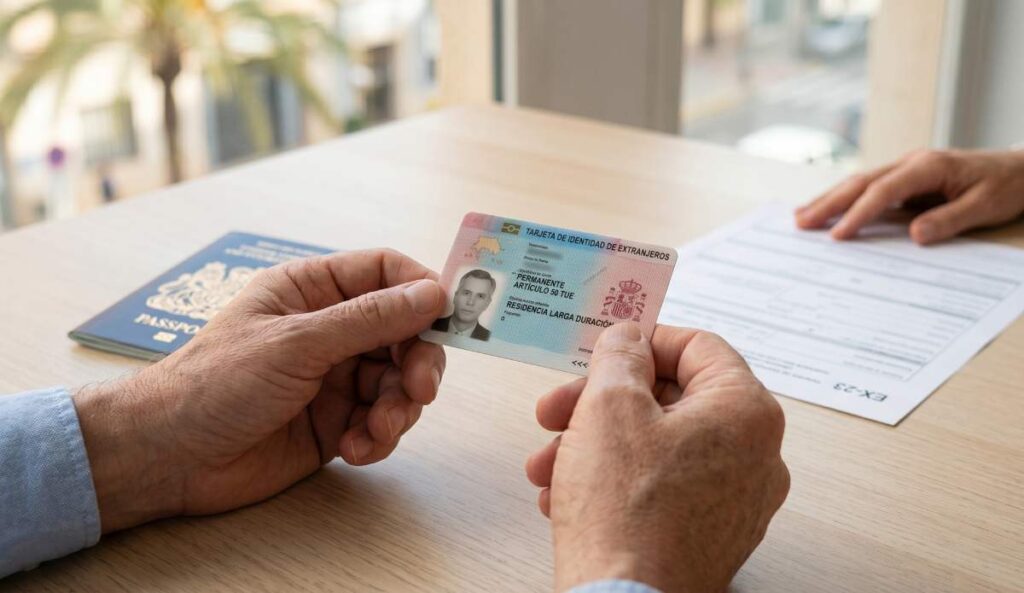
- Application form. EX-23 for Withdrawal Agreement beneficiaries and their family members. General-regime applicants bring the EX-17 once the Oficina de Extranjería has granted long-term residence. We address the distinction in the next section.
- TASA 790 código 012. €12 for a Withdrawal Agreement card and €21.87 for a long-term residence card (National Police fee list, September 2026). Must be paid before the appointment and the stamped receipt must be on you physically.
- One colour photograph. 32 by 26 mm, plain white background, taken within the last three months, no glasses, no head coverings unless for religious reasons with the face fully visible.
- Padrón certificate. Strictly speaking only required if your registered address has changed since your last TIE. We still tell our clients to bring a fresh one, issued within the previous 90 days, because some comisarías ask for it regardless.
- Appointment confirmation. Printed. We have seen officers refuse files where the applicant only had the booking on a phone screen.
What the police will NOT ask for at this appointment Bank statements, payslips, employment contracts, private health insurance certificates, empadronamiento histórico, marriage certificates or criminal record checks. If an officer asks for any of those at the exchange for permanent residency, it is either a misunderstanding or a bad interpretation of the procedure. For a Withdrawal Agreement card, politely point out that the 2 July 2020 instruction lists only passport, fee receipt and photo for the renewal and, if refused, request a denegación in writing.
EX-23 or EX-17: Choosing the Right Form
Mixing these two up is the most common reason a file gets kicked back at the counter. Pick by status, not by convenience.
You need the EX-23 if…
- You are a British national whose residence in Spain was established before 31 December 2020 (your TIE references Article 50 TEU or Article 18.4 of the Acuerdo de Retirada).
- You are a family member of a British national covered by the Agreement (family members of other EU citizens use a different form, the EX-19, and family members of Spanish citizens now follow their own residence route under Royal Decree 1155/2024).
The official PDF is available on the Ministry of Inclusion’s public repository: EX-23 form (Formulario oficial – Ministerio de Inclusión).
You need the EX-11 and then the EX-17 if…
- You are a non-EU citizen under Spain’s general immigration regime, upgrading a 5-year temporary permit to a long-term residence authorisation (Larga Duración or Larga Duración-UE). This is a two-step process: first you apply to the Oficina de Extranjería with form EX-11 (article 184 of RD 1155/2024), and once it is granted you take the EX-17 to the police for the card.
Typical profiles include American retirees who entered on a passive income visa five years ago, Latin American professionals whose work-and-residence authorisation has reached its final renewal, and family reunification cases that have matured into independent long-term residency.
Not sure which one you need?Flip your current TIE over. If the reverse says “EMITIDO BAJO ART. 18.4 ACUERDO RETIRADA” or the front shows “ARTÍCULO 50 TUE”, use the EX-23. If the card reads “RESIDENCIA TEMPORAL” with no Withdrawal Agreement reference, the EX-11 and EX-17 route is yours. Still unsure? That is one of those cases where a fifteen-minute call with our team saves you a wasted appointment.
Field 4.2 of the EX-23: The Question Everyone Gets Stuck On
Scroll through any British expat group in Spain and you will find the same recurring thread: how to fill out Section 4.2 of the EX-23 when you are moving from the five-year card to the permanent one. The form’s dropdown options were never designed with this specific scenario in mind, which is why the internet is full of contradictory answers.
Here is what we actually write on our clients’ forms, and why.
- We tick “Otros” and write “Residencia permanente / Larga duración” by hand. This matches how the officers’ internal system categorises the procedure and leaves no room for misinterpretation.
- For Group 1 applicants (people who exchanged a green EU certificate in 2020), the “Registro de ciudadano de la Unión” box is also technically correct and gets waved through without issue.
- Leaving it blank is not a disqualifier: in most provinces the system already shows your status and the officer will process the file regardless. We avoid it anyway, because a small minority of offices do return the form.
Whatever option you pick, never sign the form until you have triple-checked the personal data at the top. Typos on the passport number or NIE are a second leading cause of wasted appointments.
Step by Step: From Fee Payment to Card Collection
1. Pay the TASA 790-012
Fill in the fee form on the Policía Nacional’s e-sede, print the resulting PDF, and pay at any collaborating bank branch (BBVA, Santander, CaixaBank and the major Spanish banks accept it across the counter). Access TASA 790-012 here. The current amount is €12 for a Withdrawal Agreement card and €21.87 for a long-term residence card. The stamped receipt is non-negotiable: without it the appointment will be rescheduled.
2. Book the fingerprint appointment (Cita Previa)
Appointments are booked exclusively through the central portal operated by the Secretaría de Estado de Función Pública: Cita Previa – Policía Nacional / Oficinas de Extranjería.
Select your province, then look for one of two procedure codes. For Withdrawal Agreement files, the exact label to pick is “POLICÍA-EXP.TARJETA ASOCIADA AL ACUERDO DE RETIRADA CIUDADANOS BRITÁNICOS Y SUS FAMILIARES (BREXIT)”. For general long-term residency, pick “TOMA DE HUELLA (EXPEDICIÓN DE TARJETA) – RENOVACIÓN DE TARJETA DE LARGA DURACIÓN Y DUPLICADO”.
In Barcelona, Madrid, Málaga, Alicante and Valencia, slots disappear within seconds of being released. The release pattern varies by province. In our experience, Barcelona has been releasing slots around 09:15 and again around 14:30 on weekdays since January 2026. In smaller provinces such as Soria, Teruel or Zamora, you often get an appointment the same week.
3. Attend the appointment
You arrive ten minutes early, you hand the officer the documents in the order listed above, and you do not volunteer extra paperwork unless asked. They will take your fingerprints, confirm the basic data, and either issue a collection appointment or hand you a batch number. Keep every stamp and receipt they give you.
4. Wait for production
Card production runs through the Fábrica Nacional de Moneda y Timbre and takes between 30 and 45 days in normal conditions. The two worst backlogs we have seen in recent years were June 2022, owing to the post-pandemic catch-up, and October 2024, during the Withdrawal Agreement spike. Both episodes pushed production close to 60 days. You can track the status through the MERCURIO portal if you have a digital certificate.
5. Collect the new TIE
Depending on the province, either you receive an SMS and walk into the comisaría with your old TIE and passport, or you book a second appointment under “POLICÍA – RECOGIDA DE TARJETA DE IDENTIDAD DE EXTRANJERO (TIE)” on the same portal. Your fingerprints will be scanned one last time to confirm identity. Before you leave, verify that the card shows the correct observations. We explain what to look for below.
Before you leave the comisaría Check the card with the officer still in front of you. For WA permanent cards, the front must display “ARTÍCULO 50 TUE” and “PERMANENTE”. The reverse, under Observaciones, must read “EMITIDO BAJO ART. 18.4 ACUERDO RETIRADA”. For general long-term residency, the front shows “LARGA DURACIÓN” or “LARGA DURACIÓN-UE”. Any discrepancy must be flagged on the spot, because corrections later mean a new file and a new fee.
Can’t find a Cita Previa? Our team can help you book it.▸ REQUEST A CONSULTATION ◂
Absences Abroad: The Hidden Reason Renewals Get Denied
Time spent outside Spain during your five-year qualifying period is the single most underestimated risk factor in a TIE upgrade. The Administration pulls travel records quietly during the review, and if your absences exceed the legal thresholds, the refusal letter comes weeks after you thought the file was already approved.
The thresholds depend on your route. General regime (article 183 of RD 1155/2024): no single absence can exceed six continuous months, and all absences together cannot exceed ten months across the five years (eighteen months if the absences were for work). Withdrawal Agreement beneficiaries follow EU rules instead (Article 15 of the Agreement and Article 16.3 of Directive 2004/38): absences of up to six months a year in total do not break continuity, and one absence of up to twelve consecutive months is allowed for an important reason such as pregnancy, serious illness, study or a posting abroad.
If you suspect you are close to the limit, do not wait for the police to raise it. Build a file ahead of the appointment with payroll records, tax returns (Modelo 100 or Modelo 210), rental contracts, utility bills, school enrolments and medical consultations. That evidence is what turns a borderline case into an approved one.
The “Group 2” British Citizens: Why They Are Being Refused
This section is the one we wish every British client read before booking an appointment. It is also the subject of the majority of appeals our firm has filed during 2025 and into 2026.
Two paths, one set of rights
When the Withdrawal Agreement TIE was rolled out in July 2020, there were two routes into it. Group 1 covered UK nationals who already held the old green EU residency certificate: they exchanged paper for plastic. Group 2 covered UK nationals who had been legally resident in Spain before 31 December 2020 but had never obtained the green certificate. They applied for the TIE directly, producing whatever evidence of prior residence they could muster, and received a resolución favorable.
Both routes were, and remain, legally equivalent. Article 18.4 of the Withdrawal Agreement makes no distinction between them. Neither does Spain’s joint instruction of 2 July 2020, which specifically recognises the TIE as full proof of WA-protected status regardless of documentary path.
What is happening in practice
Since the end of 2024, some provincial police stations have begun treating Group 2 cards as if they were ordinary initial residence authorisations. The refusal line at the counter tends to be: “this TIE cannot be exchanged into a permanent card, you need to file a new application at the Oficina de Extranjería.”
That interpretation is incorrect in law. It is an internal misreading, not a change of rules, and it is not uniform across Spain. We have seen the same applicant refused in one province and accepted in a neighbouring one within the same month. The comisarías in Alicante and parts of Andalusia have been particularly problematic, whereas offices in Madrid and the Costa del Sol municipalities have been more consistent.
What to do if it happens
- Ask for the refusal in writing. A verbal “no” at the counter has no legal weight. You are entitled to a formal denegación, and the officer is obliged to produce one if you request it.
- File a recurso de alzada within one month of the written refusal. The appeal must cite Article 18.4 of the Withdrawal Agreement and the joint instruction of 2 July 2020, and it must be supported by evidence of your pre-Brexit residence. This is the legal remedy for which our firm is regularly retained.
- If urgency is an issue, consider the Defensor del Pueblo. The ombudsman has opened several files on inconsistent WA renewal practice, and a parallel complaint can accelerate the administrative response.
Our specialism MySpainVisa files Group 2 appeals for British residents across Spain. If you are in this situation, ask for a lawyer before you ask for a second opinion from the counter staff.
Denied at the Comisaría? How to Appeal
Beyond the Group 2 scenario, refusals generally cluster into three categories. The response strategy differs for each.
Paperwork gaps
A padrón older than three months, a blurry passport photocopy, a fee paid but not stamped by the bank; these are rebookable without an appeal. The challenge is the wait for a new slot. Several provinces keep a small daily quota for returning applicants that is only revealed to the person behind the counter, and it is always worth asking, politely, whether one is available.
Absences deemed excessive
When the Administration considers that your absences have broken the continuity of residence, the refusal is substantive and requires a proper defence. A refusal by the Oficina de Extranjería ends the administrative route. You can file an optional recurso de reposición before the same office within one month, or go straight to the contencioso-administrativo courts within two months, though in practice we resolve the majority of these files before reaching a judge.
Criminal record findings
Any criminal sentence registered during the five-year residence period can trigger a refusal, regardless of whether the rest of your file is spotless. Not every conviction automatically bars permanent residency. The case law distinguishes between minor and serious offences, between suspended and executed sentences, and between offences committed within Spain and abroad. These are not cases to handle without a lawyer, period.
How the recurso de alzada works, briefly
The appeal must be filed within one calendar month of the written refusal, usually electronically with a digital certificate. It is decided by the superior administrative body (the Delegación or Subdelegación del Gobierno). Silence after three months operates as a negative response, which opens the judicial review window. Properly drafted appeals against Group 2 refusals or documented absence issues have a strong track record; appeals against criminal-record refusals depend heavily on the underlying facts.
Can Any Part of This Be Done Online in 2026?
Partially, and with caveats. Spain has been progressively digitising immigration procedures through the MERCURIO and Mi Carpeta Ciudadana platforms, but the biometric core of the TIE renewal (fingerprints and physical card collection) remains in-person by design.
What you can do remotely
- Pay the TASA 790-012 electronically using a Spanish bank card and a digital certificate.
- Book (and rebook) the Toma de Huellas appointment through the central cita previa portal.
- Submit certain complementary documentation through MERCURIO if you hold a Certificado Digital FNMT, DNIe or Cl@ve Permanente.
- Track your file status post-submission and receive electronic notifications in Mi Carpeta Ciudadana.
What still requires you physically
- Fingerprint capture. No biometric exception exists for able-bodied adults.
- Card collection. The officer scans your prints against the ones taken on the first visit before releasing the new TIE.
- Any correction to the card itself once it has been printed.
Clients who prefer to minimise police station visits retain our firm through a power of attorney (apoderamiento apud acta or notarial), which allows us to submit the electronic portions, manage the MERCURIO follow-up and prepare the appointments so the only physical step left is the fingerprints. For clients outside Spain temporarily, the apoderamiento can be signed at a Spanish consulate abroad.
When MySpainVisa Can Save You Months of Paperwork
A first-time Group 1 renewal in a small province with an available appointment is a case anyone organised can handle alone. The calculation changes when any of the following variables enters the picture:
- You are a Group 2 British national and have already been told, or suspect, that your TIE will not be exchanged cleanly.
- You live in a province where citas previas have been effectively unavailable for weeks. Our appointment management system pools slots across the whole country and we regularly book clients into neighbouring provinces legally, which reopens the process.
- Your absence record during the five-year period is close to the statutory limit and needs a documented defence.
- A previous application was refused, or the comisaría has asked you to “start from scratch” at Extranjería.
- You have had any interaction with the Spanish criminal justice system during your residence, however minor.
- You cannot physically attend a comisaría appointment for medical or mobility reasons. In those cases we coordinate with the Policía Nacional for in-home fingerprinting.
- You simply want the file to land with a specialist, signed and sealed, and to free up the 10 to 15 hours that this procedure tends to eat across four to six weeks.
What retaining us actually means
A named lawyer assigned to your file from day one. Eligibility analysis before anything is filed, covering absences, income, criminal record and the Group 1 / Group 2 distinction. Preparation and submission of the correct form, correctly completed. Electronic fee payment on your behalf. Appointment booking in the fastest available province. Full remote support wherever you live in Spain, with the appointment prepared so the only step left for you is the fingerprints. Immediate drafting and filing of the right appeal if anything goes wrong. Fixed fees quoted in writing before we start.
Ask a lawyer
Renewing your TIE after 5 years, or refused at the comisaría? Send our immigration lawyers your dates and documents and we will tell you what to file and when.
Contact usFAQs About Renewing Your TIE Card After 5 Years in Spain
Can I apply for permanent residency after 5 years?
Yes, provided your five years of residence have been continuous and legal. After that threshold the right is yours under Article 15 of the Withdrawal Agreement if you are a British national covered by it, and the police simply issue the card that proves it. Under the general regime (Article 32 LOEX), you first apply to the Oficina de Extranjería for long-term residence and then collect the card.
What happens if I don’t renew my TIE?
If you let the card expire without filing within the three months after expiry, you stop being able to prove your legal status to employers, banks, landlords and border officers. In the short term that means administrative friction and possible fines under the Immigration Law (LOEX); leaving a general-regime permit expired for more than three months is a serious offence under Article 53.1.a, with fines of €501 to €10,000. Under the general regime, irregularity can force you to start the residence process from scratch as a new applicant, which is a year-long detour you want to avoid.
How long does the renewal actually take?
Four to six weeks is the typical total, counted from the fingerprint appointment to the card in your hand. Obtaining the initial appointment is the variable: a week in Soria, three months in Málaga. Plan accordingly.
How much does it cost?
The state fee under TASA 790-012 is €12 for a Withdrawal Agreement card and €21.87 for a long-term residence card. Professional fees depend on the province, how urgent the case is and how much of the file we handle. We quote them in writing before we start. Appeal cases are quoted separately.
Can I travel while the renewal is pending?
Yes. Carry your valid passport, your expired TIE, and your appointment confirmation or the resguardo from the fingerprint session. Schengen border officers recognise the documents, though we have occasionally had to step in for clients held at airport controls who travelled with only the appointment receipt. If you travel during the in-between period, print everything.
Do I need a lawyer?
Not legally. The procedure is formally open to any applicant. Whether you should retain one depends on your risk profile. A straightforward Group 1 case in a province with working appointments is manageable on your own. Everything else (absences, appeals, Group 2, criminal records, impossible provinces) benefits considerably from specialist handling.
What if my address has changed since the last TIE?
Update your padrón at your new town hall first. The fresh certificate must be dated within the 90 days prior to your police appointment and must reflect your current address. Planning: town halls in high-demand cities take anywhere from one to six weeks to issue the certificate, which means you start that trámite before you book the police appointment, not after.
Will the new card say “Permanente” or “Larga Duración”?
It depends on the legal route. Withdrawal Agreement holders receive a card with “ARTÍCULO 50 TUE” and “PERMANENTE” on the front, and “EMITIDO BAJO ART. 18.4 ACUERDO RETIRADA” on the reverse. General regime applicants receive a card with “LARGA DURACIÓN” or, if they have requested Larga Duración-UE for mobility across the EU, that second mention is added. Either reflects an equally robust permanent status; they are not ranked against each other in terms of rights within Spain.
My TIE was issued as a 10-year card from the start. Do I still need to do this?
No. A 10-year TIE issued directly at the first application means you were already recognised as a permanent resident at that moment, usually because you had completed the qualifying period before the new post-Brexit scheme was introduced. Your renewal, when it comes, will be a simple ten-year-to-ten-year exchange, not an upgrade.
About this guide for TIE Card after 5 years in Spain
This article has been prepared by the immigration department of MySpainVisa, a Spanish law firm specialising in residency, nationality and administrative appeals before the Policía Nacional and the Subdelegación del Gobierno. The content is based on Ley Orgánica 4/2000, Real Decreto 1155/2024, the EU-UK Withdrawal Agreement and the joint instruction of 2 July 2020 on the Withdrawal Agreement residence document.
The information above is general in nature and does not amount to legal advice on any specific case. Individual circumstances change outcomes, and nothing in this article replaces a formal consultation. If you would like an assessment of your own file, our team can be reached through the contact details on this site.