How to Get a NIE in Spain Online (2026 Guide)
NIE Spain: 2026 Quick Guide
- 📋 What is a NIE: Tax ID for foreigners with ties to Spain.
- 🏦 When needed: Property, bank accounts, work or taxes.
- 📂 Documents: EX-15, passport, proof of reason, Form 790 (~€10).
- ⏱️ Wait time: 4–8 weeks in big cities, less elsewhere.
- ✅ How to apply: In Spain, at a consulate, or via representative.
- ♾️ Validity: NIE number never expires.
Need it fast? We can get your NIE in 10–15 days, fully remote.
👉 Apply for Your NIE Online- ❤️ What Is a NIE Number in Spain?
- 🎧 Who Needs a NIE Number in Spain?
- ❤️ How to Get a NIE in Spain: Step by Step (2026)
- 🌍 How Long Does It Take to Get a NIE in Spain?
- 🥇 Documents Required for a NIE in Spain
- ✅ Get Your NIE in Spain Online: Our Service
- 👍 How Much Does a NIE Cost in Spain in 2026?
- ✅ Can You Live in Spain Without a NIE?
- ⚖️ FAQs About NIE Numbers in Spain
Getting a NIE in Spain sounds straightforward, until you try to book an appointment and realise the next available slot is eight weeks away. At our law firm we deal with NIE applications every week, and the most common mistake people make is underestimating how early they need to start the process. This guide gives you an honest, up-to-date picture of how it works in 2026, what documents you actually need, and what your options are if you can’t afford to wait.
What Is a NIE Number in Spain?
The NIE (Número de Identificación de Extranjero) is a unique tax identification number that Spain assigns to foreign nationals who have economic, professional, or social ties to the country. It is not a residence permit, nor proof that you live in Spain, it is simply a number that identifies you before the Spanish authorities for any official purpose.
You will need it to:
- Sell or Buy property in Spain
- Open a Spanish bank account
- Sign an employment contract
- Pay Spanish taxes or file a tax return
- Register a vehicle in your name
- Apply for a mortgage
- Receive an inheritance
The number is permanent. Once it is assigned to you, it never changes and never expires, regardless of whether you later become a resident, leave Spain, or change your passport.
What does a NIE number look like?
A NIE always starts with a letter X, Y, or Z followed by seven digits and a final control letter. For example: Y-1234567-A. The letter X was used first; Y is the most common for individual applicants today. The letter Z is reserved for foreign legal entities such as companies.
NIE, TIE, and certificate of registration: clearing up the confusion
These three terms are frequently confused, and it matters to get them right:
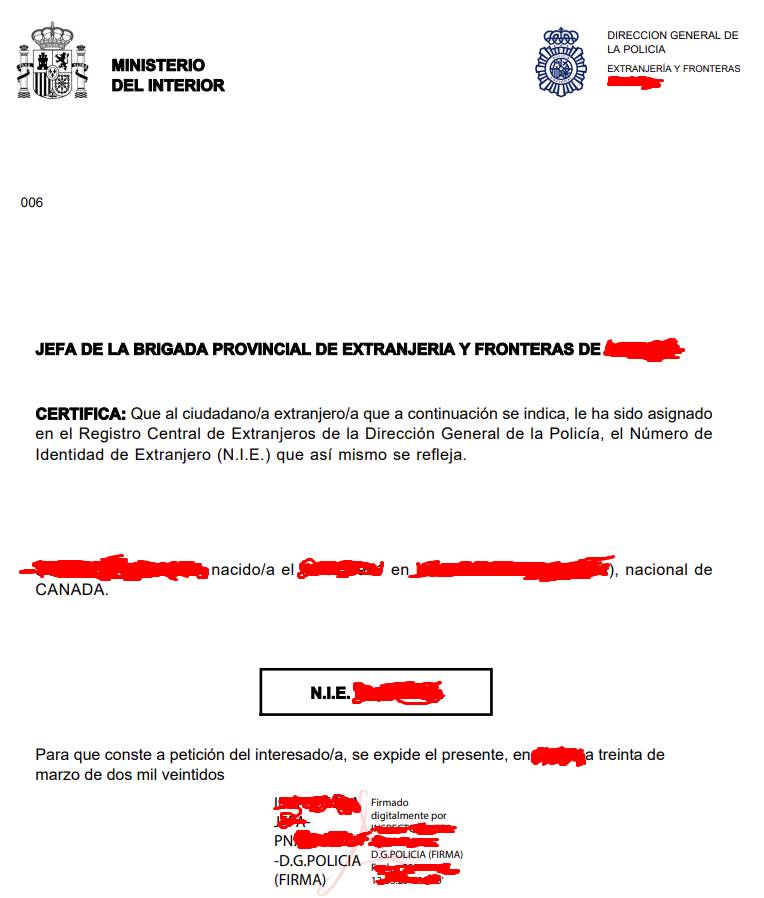
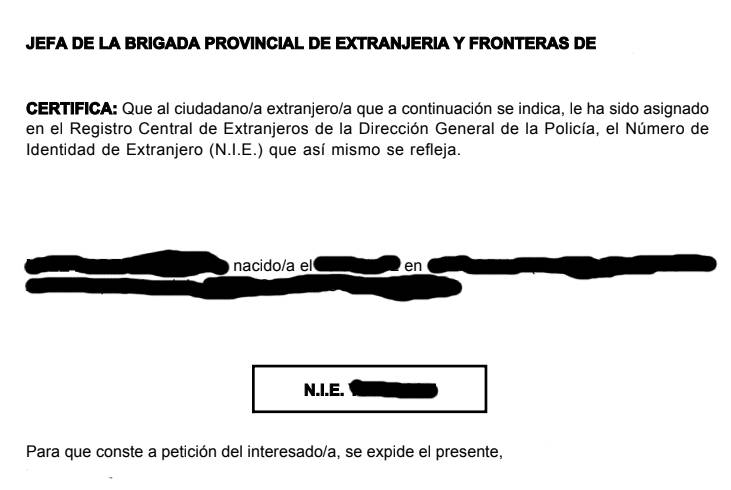
- The NIE is an identification number, not a physical card. When issued to a non-resident for a specific purpose, such as buying a property, it comes as an A4 white document. This is what is commonly called the white NIE.
- The TIE (Tarjeta de Identidad de Extranjero) is a physical residence card issued to non-EU nationals living in Spain. It contains a NIE number, but it is a different document with a different purpose.
- EU citizens who establish residence in Spain do not receive a TIE. Instead, they obtain a certificate of registration (certificado de registro de ciudadano de la UE), which also includes their NIE number.
If you are a non-resident needing to complete a property purchase, open a bank account, or manage assets in Spain, the document you need is the white NIE and that is what this guide focuses on.
An important practical note on the white NIE
The NIE number itself does not expire. However, in certain notarial and registry contexts, particularly property transactions, the notary may require you to provide updated documentation proving your current non-resident status. This is not because the NIE has expired, but because the administrative accreditation of your fiscal situation needs to be current at the time of signing. If you obtain your white NIE but then delay your transaction by several months, it is worth checking with your lawyer whether any supplementary document will be required before you sign.
Who Needs a NIE Number in Spain?
The short answer is: any foreign national who needs to carry out an official transaction in Spain. But let’s be more specific, because the type of NIE you need, and the process to obtain it, can vary depending on your situation.
Non-EU citizens living outside Spain
This is the most common profile we deal with at our firm. You don’t live in Spain, you’re not planning to move there, but you need a NIE to complete a specific transaction, most often a property purchase, an inheritance, or the opening of a bank account.
In this case you need the white NIE (non-resident NIE). You can apply through the Spanish consulate in your country of residence, or you can authorise a representative in Spain to apply on your behalf through a power of attorney. The second option is almost always faster and less complicated in practice.
EU citizens moving to Spain
If you are an EU citizen planning to live in Spain, you are required to register at the Central Registry of Foreign Nationals (Registro Central de Extranjeros) within three months of your arrival. This process automatically assigns you a NIE number, which will appear on your registration certificate.
You do not need to apply for a white NIE separately, the registration process covers it.
Non-EU citizens moving to Spain
If you are a non-EU citizen relocating to Spain, your NIE number will be assigned as part of your residency application. You will receive it on your TIE card (Tarjeta de Identidad de Extranjero) once your visa has been approved, you do not need to apply for a white NIE separately.
The most common routes our clients use to move to Spain are the Non-Lucrative Visa, designed for those who can support themselves financially without working in Spain, and the digital nomad visa for Spain, aimed at remote workers and freelancers who work for clients or companies outside Spain. In both cases, the NIE number appears on the visa itself once it is approved, and after arriving in Spain you will need to apply for your TIE card to formalise your residency.
That said, there are situations where non-EU nationals who are already legally in Spain need a white NIE urgently, for example, to complete a property purchase before their residency card has been issued. This is more unusual but it does happen, and it is manageable.
Minors and incapacitated persons
Children and incapacitated individuals can also be assigned a NIE. In these cases, the application must be submitted by a parent or legal guardian, who will need to provide the relevant family documentation, birth certificate, family record book, or guardianship document, alongside the standard NIE paperwork
Foreign companies and legal entities
Foreign companies that have fiscal obligations in Spain, for example, due to EPR legislation, property ownership, or commercial activity, are assigned a NIF (Número de Identificación Fiscal) rather than a NIE. The NIF for foreign legal entities starts with the letter N. If you are reading this on behalf of a company rather than as an individual, this is a separate procedure.
How to Get a NIE in Spain: Step by Step (2026)
There are three ways to obtain a white NIE in Spain. Which one applies to you depends on where you are based and how much time you have. We’ll walk through each one honestly.
Option A: Applying in Person for yor NIE in Spain
This is the official route for anyone who is already in Spain and wants to handle the process themselves.
Step 1: Book your appointment (cita previa)
You must request an appointment through the official Spanish government website. Depending on your province, select:
- Certificados UE if you are an EU citizen
- Expedición de tarjeta de identidad de extranjero if you are a non-EU citizen
Be realistic about timing. In cities like Madrid or Barcelona, the next available appointment can be 4 to 8 weeks away. In smaller provinces the wait is shorter, but it is rarely immediate. Book as early as possible, ideally the same day you decide you need a NIE.
Step 2: Complete form EX-15
Download and complete the EX-15 application form in Spanish. You will need to fill it in duplicate. The form asks you to state the reason why you are requesting the NIE, this is mandatory and cannot be left vague. Accepted reasons include a property purchase agreement, an employment contract, or other documentation that demonstrates a genuine economic, professional, or social interest in Spain.
Step 3: Pay the NIE fee
The NIE fee in 2026 is €9.84, paid using Form 790, code 012. You can complete the form online, print it, and pay at any Spanish bank. Payment by direct debit from a Spanish account is also accepted. Keep the payment receipt, you will need it at your appointment.
Step 4: Gather your documents
Bring the following to your appointment:
- EX-15 form (original and one copy, completed in Spanish)
- Valid passport (original and copy of the biographical data page)
- Document proving the reason for your NIE request (property contract, employment offer, etc.)
- Proof of payment of Form 790
- If applying as a minor: birth certificate or family record book, plus the ID of the parent or guardian
Make copies of everything. Spanish immigration offices routinely require duplicates of every document, and arriving without them means starting over.
Step 5: Attend your appointment
Go to your designated Oficina de Extranjeros or Policía Nacional office with all your documents. Depending on the province, you may receive your NIE certificate on the same day or be asked to return within 5 to 10 working days to collect it.
Option B: Applying Through the Spanish Consulate Abroad
If you are outside Spain and need a NIE before travelling, you can apply through the Spanish consulate in your country of residence.
The documentation required is essentially the same as Option A, form EX-15, passport, proof of reason, and payment of the fee, but the process is handled by the consulate rather than the police. Each consulate has its own appointment procedures, so check the specific requirements for your country before assuming the process is identical everywhere.
The main drawback of this route is time. Processing through a consulate typically takes 6 to 10 weeks, and in some countries the wait for a consulate appointment itself adds further delays. If your transaction has a fixed deadline, a property completion date, for example, this timeline can be a serious problem.
Option C: Through a Representative with Power of Attorney (The Online Route)
This is the option that works for most of our clients, particularly those based outside Spain or those who cannot afford to wait weeks for an appointment.
Spanish law allows a third party, such as a law firm, to apply for your NIE on your behalf, provided you grant them a power of attorney (poder notarial) authorising them to do so. You do not need to travel to Spain. You do not need to book an appointment yourself. The entire process is handled remotely.
How it works in practice:
- You provide us with your personal details and the reason for your NIE request
- We prepare the power of attorney document
- You sign it before a notary in your country of residence
- The document is legalised with the Apostille of The Hague, a mandatory stamp that validates Spanish legal documents signed abroad
- You send us the legalised document (physically or digitally, depending on the notary)
- We submit your NIE application in Spain on your behalf
Timeline: 10 to 15 working days from the moment we receive your legalised power of attorney.
A note on the Apostille of The Hague
This is the step that surprises most people. If you sign a power of attorney outside Spain, it cannot be used before Spanish authorities unless it bears the Apostille stamp issued by the competent authority in your country. This is not optional and cannot be skipped. The good news is that in most countries this process can now be completed online through certified notarial services, without needing to visit a government office in person. We guide all our clients through this step as part of our service.
How Long Does It Take to Get a NIE in Spain?
This is the question we get asked most often, and the honest answer is: it depends entirely on how you apply.
One of the most common mistakes people make is assuming they can sort out their NIE in the week before they need it. In our experience, that is rarely possible through the official channels, particularly in high-demand cities. Below is a realistic breakdown of what to expect in 2026.
| Application Method | Appointment Wait | Processing Time | Total Estimate |
|---|---|---|---|
| In person in Spain (Madrid / Barcelona) | 4–8 weeks | 5–10 working days | 6–10 weeks |
| In person in Spain (smaller provinces) | 1–3 weeks | 5–10 working days | 2–5 weeks |
| Spanish consulate abroad | 2–6 weeks | 6–10 weeks | 8–16 weeks |
| Representative with power of attorney | No appointment needed | 10–15 working days | 10–15 working days |
Why do appointments take so long?
Demand for NIE appointments in Spain has increased significantly in recent years, driven by a growing number of foreign nationals buying property, relocating under the Non-Lucrative Visa or the Digital Nomad Visa, and managing cross-border assets and inheritances. The appointment system (cita previa) is managed centrally by the Spanish National Police, and availability varies enormously depending on your province and the time of year.
Summer months and the period around property purchase peaks, typically spring and autumn, tend to be the most congested. If you are planning a transaction with a fixed completion date, factor this in from the start.
What if I have a deadline?
If you have a notary signing date, a contract exchange, or any other fixed deadline, the power of attorney route is almost always the most reliable option. It removes the appointment bottleneck entirely and gives you a predictable timeline from day one.
If your deadline is very tight, less than two weeks, contact us directly before starting the process so we can assess whether it is achievable in your specific case
Documents Required for a NIE in Spain
Regardless of which application route you choose, the core documentation is the same. Here is what you will need to prepare.
Standard documents for all applicants
- Form EX-15: the official NIE application form, completed in Spanish, in duplicate and signed by the applicant or their authorised representative
- Valid passport: original and a copy of the biographical data page. EU citizens may use their national identity card instead
- Proof of reason for the NIE request: this is mandatory and must be specific. Accepted documents include a property purchase agreement, a preliminary sale contract (contrato de arras), an employment contract, a mortgage offer, or similar documentation demonstrating a genuine economic, professional, or social interest in Spain
- Form 790, code 012: proof of payment of the NIE fee (€9.84 in 2026), paid at a Spanish bank or by direct debit
Additional documents depending on your situation
| Situation | Additional document required |
|---|---|
| Applying through a representative | Original power of attorney (poder notarial) authorising the representative, plus a copy of their ID |
| Applicant is a minor | Birth certificate or family record book, plus valid ID of parent or guardian |
| Signing power of attorney abroad | Apostille of The Hague on the notarised document |
| Non-EU citizen in Spain | Visa or entry stamp if applicable |
A practical note on copies
Spanish administrative offices almost always require both the original and at least one photocopy of every document you submit. Arriving without copies is one of the most frequent reasons appointments are cut short and applicants are sent away to try again. If you are applying in person, make two copies of everything to be safe.
Get Your NIE in Spain Online: Our Service
At MySpainVisa we are a law firm specialising in Spanish immigration and tax procedures for foreign nationals. We process NIE applications every week for clients based all over the world, from the United States and the United Kingdom to Australia, the Middle East, and across Europe.
If you need your NIE and cannot travel to Spain, do not want to deal with the appointment system, or simply have a deadline that does not allow for delays, this is how we can help.
How our NIE online service works
- 1. Send us your details Fill in our contact form with your personal information and the reason you need a NIE. We will confirm whether your case is straightforward or whether it requires any additional documentation before we start.
- 2. We prepare your power of attorney Our legal team drafts the poder notarial, the power of attorney document that authorises us to represent you before the Spanish authorities. We send it to you ready to sign.
- 3. You sign before a notary You sign the document in front of a notary in your country of residence. In most countries this can now be done online through certified digital notarial services, without visiting an office in person.
- 4. Apostille of The Hague If you are signing outside Spain, which is the case for most of our international clients, the notarised document must be validated with the Apostille of The Hague before it can be used before Spanish authorities. We explain exactly how to obtain this in your country, and we work with partners in several countries who can handle it quickly if needed.
- 5. You send us the legalised document Once your power of attorney has been notarised and apostilled, you send it to us. In many cases a certified digital copy is sufficient, we will confirm this based on your specific situation.
- 6. We submit and follow up We submit your NIE application in Spain on your behalf, attend the appointment, and follow up with the authorities until your NIE certificate is issued. You receive your NIE by email as a scanned official document.
Timeline and what to expect
Our standard processing time is 10 to 15 working days from the moment we receive your legalised power of attorney. This is significantly faster than applying through a consulate abroad and avoids the weeks-long wait for an in-person appointment in Spain.
We keep you informed throughout the process and you will always have a direct point of contact at our firm, not a chatbot, not an automated system.
How Much Does a NIE Cost in Spain in 2026?
The official fee for the assignment of a NIE number is €9.84 (Form 790 code 012). If what you need is a NIE certificate (certificado de NIE or the EU registration certificate), the fee is €12.00. They are different procedures on the same fee form, which is why you will see both figures quoted online. Both are paid at a Spanish bank before your appointment, and we include the correct fee form, pre-filled, in every NIE file we prepare.
Can You Live in Spain Without a NIE?
Not in practice. The NIE is required to buy or rent property, open a bank account, sign an employment contract, pay taxes, buy a car, connect utilities or inherit assets. You can enter Spain and stay as a tourist without one, but the moment you do anything economic or legal in Spain, you will be asked for a NIE. That is why we obtain it at the start of every residency file, including for clients applying for Spain’s passive income visa.
FAQs About NIE Numbers in Spain
What is a NIE number in Spain?
The NIE (Número de Identificación de Extranjero) is a unique, permanent tax identification number assigned to foreign nationals who have economic, professional, or social ties to Spain. It is required for virtually any official transaction in the country, buying property, opening a bank account, signing an employment contract, paying taxes, or receiving an inheritance. The number never expires and never changes, regardless of your residency status.
Can anyone get a NIE number in Spain?
Any foreign national who can demonstrate a genuine economic, professional, or social reason for needing one can apply for a NIE. You do not need to be a resident of Spain, and you do not need to be physically present in the country, you can apply through the Spanish consulate in your country of residence or authorise a representative in Spain to apply on your behalf. What you cannot do is apply without a valid reason. The application form requires you to specify and document why you need the number.
Can I live in Spain with just a NIE?
No. The NIE is an identification number, not a residence permit. Having a NIE does not give you the right to live or work in Spain. If you are a non-EU citizen and wish to relocate to Spain, you will need to apply for the appropriate visa first, such as the Non-Lucrative Visa or the Digital Nomad Visa, and your NIE will be assigned as part of that process. EU citizens who move to Spain must register at the Central Registry of Foreign Nationals within three months of arrival, which is a separate procedure from the white NIE.
Does a NIE number expire?
The NIE number itself never expires, it is assigned to you permanently and remains valid for life. However, the white NIE certificate issued to non-residents may need to be supplemented with updated documentation in certain administrative contexts, particularly in property transactions, where the notary may require proof of your current fiscal situation at the time of signing. If you obtained your NIE some time ago and are now completing a transaction, it is worth checking with your lawyer whether any additional document is needed.
How long does it take to get a NIE in Spain?
It depends on how you apply. In person in Spain, you first need to secure an appointment, which in cities like Madrid or Barcelona can take 4 to 8 weeks. Once the appointment is done, the NIE is typically issued within 5 to 10 working days. Through a Spanish consulate abroad, the total process can take anywhere from 8 to 16 weeks depending on your country. If you apply through a law firm using a power of attorney, the process takes 10 to 15 working days from the moment the legalised document is received, with no appointment wait.
How much does a NIE cost in Spain in 2026?
The official government fee is €9.84, paid using Form 790, code 012, at any Spanish bank. This is the only fee charged by the Spanish authorities. If you use a law firm or a representative to manage the application on your behalf, their professional fees are separate and will depend on the service provider.
Can I get a NIE without being in Spain?
Yes. You have two options. The first is to apply through the Spanish consulate in your country of residence, which requires an appointment and can take several weeks. The second and generally faster, option is to grant power of attorney to a representative or law firm in Spain, who will submit the application on your behalf. If you sign the power of attorney outside Spain, it must be notarised and validated with the Apostille of The Hague before it can be used before Spanish authorities.
What is the difference between a NIE and a TIE?
The NIE is a number, your permanent foreign identification number in Spain. The TIE (Tarjeta de Identidad de Extranjero) is a physical residence card issued to non-EU nationals who live in Spain, which contains their NIE number among other information. They are related but distinct: you can have a NIE without having a TIE, but you cannot have a TIE without a NIE. Non-residents typically only need the NIE; residents need both.
Do children need a NIE in Spain?
Yes, if they have a legal or financial reason to be identified before the Spanish authorities, for example, if they are included in a property purchase or an inheritance. The application must be submitted by a parent or legal guardian, who will need to provide the birth certificate or family record book alongside the standard NIE documentation.
Can I open a Spanish bank account without a NIE?
In most cases, no. Spanish banks require a NIE before opening an account for a foreign national. Some banks may accept an application in progress, but the account will typically remain restricted until the NIE is provided. If you are planning to move to Spain or complete a property purchase, obtaining your NIE early in the process will avoid unnecessary delays further down the line.
Once the file is in, you can check your NIE application status online instead of phoning the office and waiting.
Why choose us for your
?
We are a Spanish law firm founded in 2010, with more than 15 years of experience. We are specialists in immigration and real estate, ensuring your process is handled by true experts.
If you need expert legal help, contact us today!