Best places to live in Spain
The best places to live in Spain for expats, going by the eleven cities this guide covers, are Barcelona, Madrid, Valencia, Malaga, Alicante, Seville, San Sebastian, Granada, Bilbao, Zaragoza and Ibiza. Valencia is the one most people end up choosing once they compare rents, because it is the only large Spanish city that is coastal, affordable and well connected at the same time. Malaga and Alicante win on climate, cost and the size of the English-speaking community. Madrid and Barcelona win on jobs, international schools and flights. Bilbao and San Sebastian suit people who prefer mild summers to a beach. Granada is the cheap university city, Zaragoza the calm option for families, Ibiza the island for remote workers.
If you are not an EU, EEA or Swiss citizen you will need a visa first: the non-lucrative visa, the retirement route, the digital nomad visa or the self-employed visa. Our lawyers handle all of them.
The short answer: best places to live in Spain by what you need
If you want the answer before the detail, this is how the cities below sort by priority. Each line is the city we most often end up recommending for that situation, based on the enquiries we have handled since 2021.
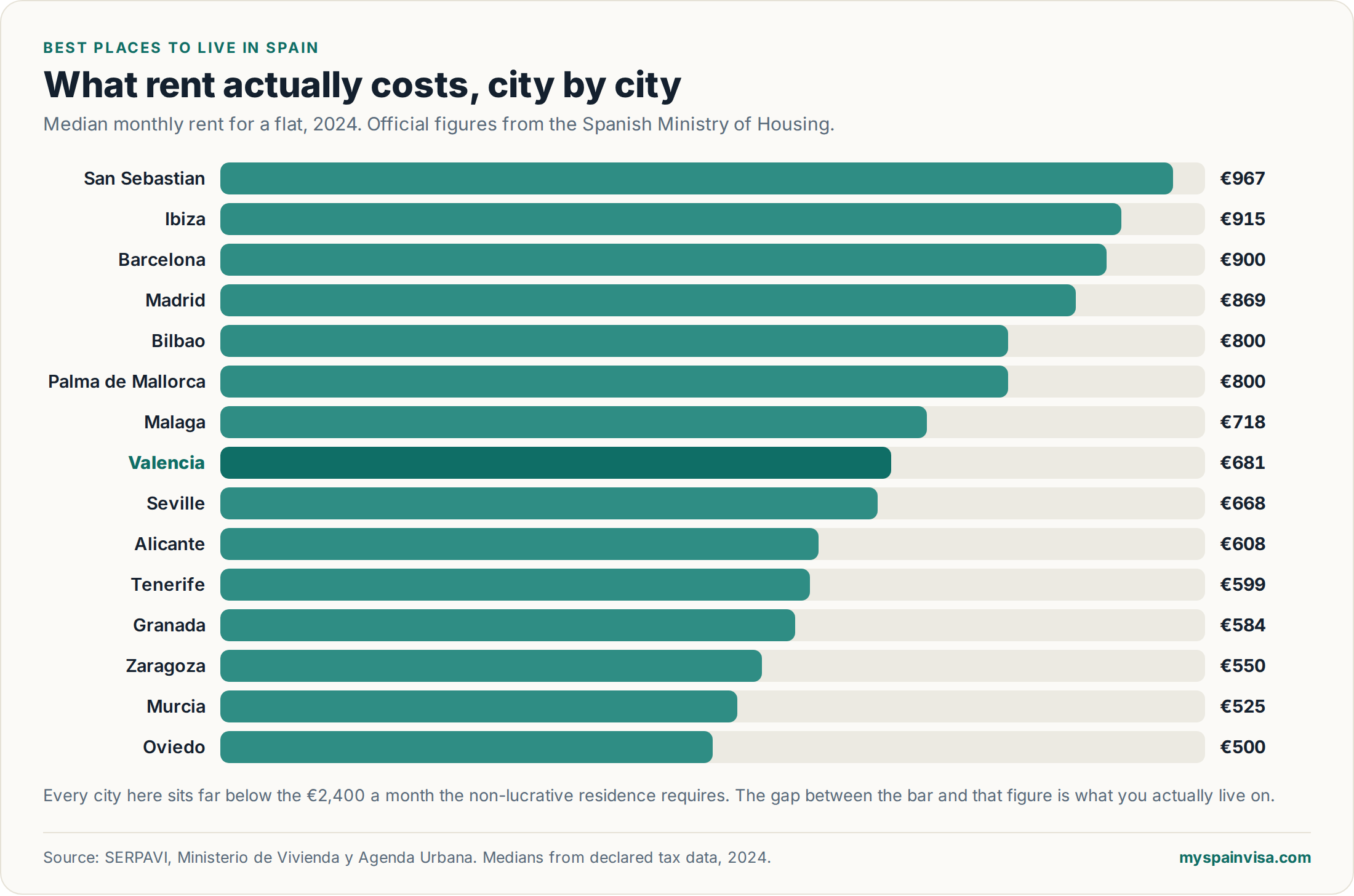
- Best overall for most peopleValenciaCoastal, affordable and a real city, at a 681 euro median rent.
- Jobs and English-speaking workMadrid
- International careers and start-upsBarcelona
- Retiring on a fixed incomeValencia, Murcia or Alicante
- Lowest cost of livingOviedo, Murcia and ZaragozaAll under 555 euros median rent.
- Year-round warmthTenerife and the Canary Islands
- Families who want calmZaragoza or Bilbao
- Mild summersBilbao, San Sebastian and the green north
- Students and tight budgetsGranada
- Island life with a real cityPalma de Mallorca
One caution before you pick from that list. If you are not an EU citizen, your residence permit decides your budget before your taste does, and the income thresholds are national rather than local. Working through your situation in order takes about two minutes in our where should I live in Spain quiz, which asks for your budget and your work situation and returns the cities that actually fit both.
Where people moving to Spain actually ask us to go
Most rankings of the best places to live in Spain are built from a writer’s own trip. Ours is built from our inbox. Since 2021 we have handled thousands of written enquiries from people planning a move to Spain, and a large share of them name the city they have in mind. We counted those mentions across our own case records. What follows is not a list of pretty towns, it is the map of where demand actually sits.
Two things surprised us. Barcelona is named far more often than Madrid, even though Madrid is the bigger city and the capital. And Valencia, which barely appears in older guides, is now the third most requested destination in the country and the single most requested city among people applying for the non-lucrative residence.
| City | Demand rank in our records | Median rent, flat, 2024 | Who it tends to suit |
|---|---|---|---|
| Barcelona | 1 | €900 | Professionals, families, city life |
| Madrid | 2 | €869 | Jobs, English-speaking work, culture |
| Valencia | 3 | €681 | Retirees and remote workers who want a city with a beach |
| Mallorca (Palma) | 4 | €800 | Island life with an airport and a hospital |
| Tenerife | 5 | €599 | Year-round warmth, and IGIC instead of mainland VAT on most purchases |
| Malaga | 6 | €718 | Coastal living with a large established expat community |
| Alicante | 7 | €608 | Beach on a smaller budget |
| Murcia | 8 | €525 | Lowest cost on the southern coast |
| Ibiza | 10 | €915 | Remote workers who accept a seasonal economy |
| Marbella | 11 | €800 | Costa del Sol living with a large international community |
| Seville | 14 | €668 | Andalusian life, hot summers |
| Granada | 15 | €584 | Students and tight budgets |
| Zaragoza | Outside the top 15 | €550 | Families who want calm and low rents |
| Bilbao | Outside the top 15 | €800 | Mild summers, green north, strong public services |
| San Sebastian | Outside the top 15 | €967 | Food and coastline, at the highest rents in Spain |
| Oviedo | Outside the top 15 | €500 | The cheapest of the northern cities |
Read the rent column with one caveat we would rather state than hide. SERPAVI medians come from rents actually being paid on existing contracts, declared to the tax authority. They are not today’s asking prices on a property portal, and a new contract in Barcelona or Valencia will usually cost more than the figure above. We use them because they are official, they cover the whole market rather than the listings someone chose to advertise, and they are consistent from one city to the next. You can check any municipality yourself at the Ministry of Housing rental price reference system.
Americans and Britons do not pick the same Spain
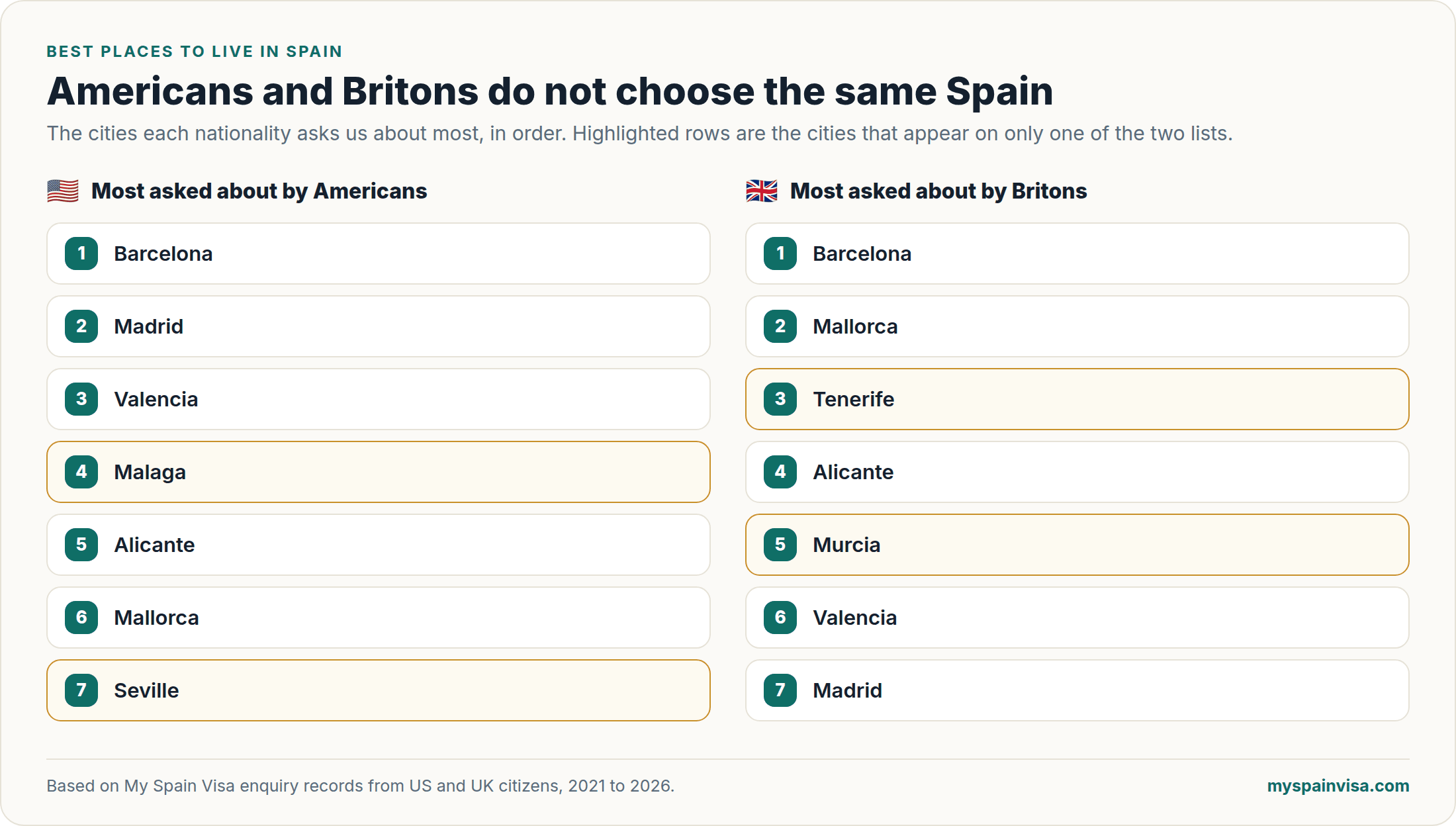
Split the same enquiries by nationality and two different countries appear. Among the enquiries we receive from Americans, the three most named places are Barcelona, Madrid and Valencia. All three are large mainland cities. Among the enquiries from British citizens, Barcelona still leads, but Mallorca and Tenerife come second and third, and Murcia appears in the top five. Americans are choosing cities. Britons are choosing coastline and islands.
The pattern is consistent enough that it is worth saying plainly. If you are American and you are reading a list written for a British audience, it will point you at the Costa Blanca and the Canaries when the people most like you are ending up in Valencia and Madrid. The reverse is also true. If you are American, our guide on how to move to Spain as an American covers the visa and the consulate for your state.
| Rank | Most named by Americans | Most named by Britons |
|---|---|---|
| 1 | Barcelona | Barcelona |
| 2 | Madrid | Mallorca |
| 3 | Valencia | Tenerife |
| 4 | Malaga | Alicante |
| 5 | Alicante | Murcia |
| 6 | Mallorca | Valencia |
| 7 | Seville | Madrid |
Your visa narrows the list before your taste does
This is the part a travel blog cannot tell you. The residence permit you qualify for changes which cities are realistic, and we see it in the same data. Among people asking about the non-lucrative residence, the route most retirees use, Valencia comes second, after Barcelona. Among people asking about the digital nomad visa, Barcelona is named more than twice as often as anywhere else. Retirees are optimising for cost and calm, remote workers for connectivity and other remote workers.
It matters financially too. The non-lucrative residence requires proof of 2,400 euros a month in sufficient means for the main applicant, whether that comes from pensions and other regular income or from savings you can show are available, and that figure does not change by city. Add 600 euros a month for each family member who comes with you, so a couple is looking at 3,000. In Oviedo or Murcia it buys a comfortable life. In San Sebastian, where the median rent is 967 euros, it does not stretch nearly as far. Choosing the city before checking the income threshold is the most common ordering mistake we see.
Questions we get asked most about where to live in Spain
These are the questions that come into our inbox more than any other, answered with the official figures rather than with opinion.
Where are the biggest expat communities in Spain?
Not where most people assume. The largest British communities in Spain are not in the cities at all. On INE’s Annual Population Census at 1 January 2025, Alicante province has 68,904 British nationals and Malaga province 49,298, followed by the Balearics with 18,448, Murcia with 16,522 and Barcelona with 15,818. Almeria, at 15,397, is almost level with Barcelona in raw numbers despite being a far smaller province, which tells you how concentrated the British presence is down there.
The American map is almost the reverse. On the same 2025 census Madrid holds 14,240 US nationals and Barcelona 11,251, and then it drops off a cliff: Valencia has 4,907 and Malaga 3,945. If you want to be surrounded by other Americans you go to a big city. If you want to be surrounded by other Britons you go to the coast.
Where do most Americans live in Spain?
Madrid first, Barcelona second, and the gap to everywhere else is wide. Valencia and Malaga, third and fourth, register 4,907 and 3,945 against Barcelona’s 11,251. Our own enquiries match the register closely, with Barcelona, Madrid and Valencia as the three most requested. Valencia is the one that has moved: it barely featured five years ago and now sits third both in what people ask us for and in the official count.
Population figures above: INE, Annual Population Census, foreign residents by province and nationality at 1 January 2025 (ine.es).
The practical reason is work. Madrid has the deepest market for English-speaking roles in Spain, and Barcelona the most international companies. Retirees split differently, which is why the Costa del Sol and the Costa Blanca look so British and so much less American.
What are the best small towns in Spain for expats?
A small town in Spain works on one condition, which is that you either speak Spanish already or you accept being the foreigner for a few years. With that said, these are the ones people ask us about most, with the 2024 official median rent for a flat:
| Town | Province | Median rent, flat, 2024 | Suits |
|---|---|---|---|
| Torrevieja | Alicante | €430 | The cheapest established expat town on the coast |
| Ribadeo | Lugo | €375 | Green north, cool summers, almost no expat scene |
| Almuñécar | Granada | €500 | Tropical coast, quiet out of season |
| Dénia | Alicante | €561 | Ferry to the Balearics, strong food scene |
| Nerja | Málaga | €575 | Costa del Sol without Marbella prices |
| Altea | Alicante | €616 | The prettiest of the Costa Blanca towns |
| Estepona | Málaga | €675 | Marbella neighbour, better value |
The trade-off nobody mentions is medical. A town of ten thousand people will usually have a health centre, with the nearest hospital in the area capital. Sometimes that is twenty minutes away and sometimes it is an hour. If you are over seventy or managing a condition, check where the nearest hospital actually is before you fall in love with a view.
What is the safest city in Spain to live in?
Spain records one of the lower homicide rates in the EU on Eurostat’s figures, and no city on this list stands out as dangerous by European standards, so the honest answer is that the question is usually asked at the wrong scale. Safety in Spain varies by neighbourhood and by hour far more than it varies by city.
The practical test we give people looking at a flat is simple. Walk the street at eleven at night on a Tuesday. If it is lit and there are people on it, that tells you more than any city ranking will. By that measure the city centres usually come out better than the quiet hillside urbanisations that photograph so well on property portals, which is the opposite of what most buyers expect. The complaint we hear most often from clients in Barcelona, Madrid and Seville is pickpocketing in tourist areas. It is opportunistic theft rather than confrontation, but it is common enough that you should carry your documents accordingly.
Where should I live in Spain if I only speak English?
Madrid and Barcelona if you need to work, because that is where the English-speaking jobs are. The Costa Blanca and the Costa del Sol if you do not, because decades of British residence mean you can handle a bank, a doctor and a plumber in English in a way that takes longer to arrange in cities with less of that history, such as Zaragoza or Oviedo.
Two warnings from experience. Valencia and Seville feel easy in the centre and get hard quickly outside it. And in Catalonia and the Basque Country the co-official language carries much of the school day, which matters most if you are putting children into a state school. Both systems work well for children, who pick it up quickly. It is the parents who feel it first. None of this is a reason to avoid those places. It is a reason to be honest with yourself about how much Spanish you intend to learn.
Every situation differs, and where you live interacts with which residency route fits you and where you end up paying tax. Our advisors go through both together before anyone signs a lease.
The 11 best places to live in Spain for expats
Are you searching for the best places to live in Spain? Whether you’re a young adult, a family, or a retiree, Spain offers a wide range of expat-friendly cities that cater to every lifestyle. At MySpainVisa, we’ve carefully curated a list of the top destinations for expats, ensuring you find the perfect place to call home. Let’s explore one of the most popular choices: Barcelona.
Barcelona: for young professionals, families and city lovers

Barcelona is not just a city; it’s a lifestyle. Known for its vibrant atmosphere, stunning architecture, and rich cultural scene, it’s no wonder that Barcelona is one of the best places to live in Spain for young adults, families, and even retirees. Here’s why:
- Affordable Living: Dining out in Barcelona is surprisingly affordable, with meal costs ranging from €7 to €20. Whether you’re looking for budget-friendly restaurants or high-quality dining experiences, Barcelona has something for everyone.
- Quality of Life: Beyond its iconic landmarks like La Sagrada Familia and Park Güell, Barcelona offers a high quality of life with its diverse activities, year-round events, and access to international schools. It’s also one of the best places to live in Spain for Americans, thanks to its expat-friendly environment.
- Family-Friendly: With its safe neighborhoods, scenic coastal areas, and excellent amenities, Barcelona is a top choice for families. The city provides a perfect balance of urban living and natural beauty, making it ideal for raising children.
- Retirement Haven: Barcelona is also becoming a popular destination for retirees. The city offers comprehensive services, a relaxed Mediterranean lifestyle, and a vibrant community that caters to retirees’ needs.
Valencia: for retirees and remote workers who want a city with a beach
Valencia is the city we are asked about most after Barcelona and Madrid, and it is the only large city in Spain that gives you a beach, a metro, a major hospital and a median rent under 700 euros at the same time. Our enquiry data puts it third overall, and second, after Barcelona, among people asking about the non-lucrative residence. That combination is why it keeps winning.
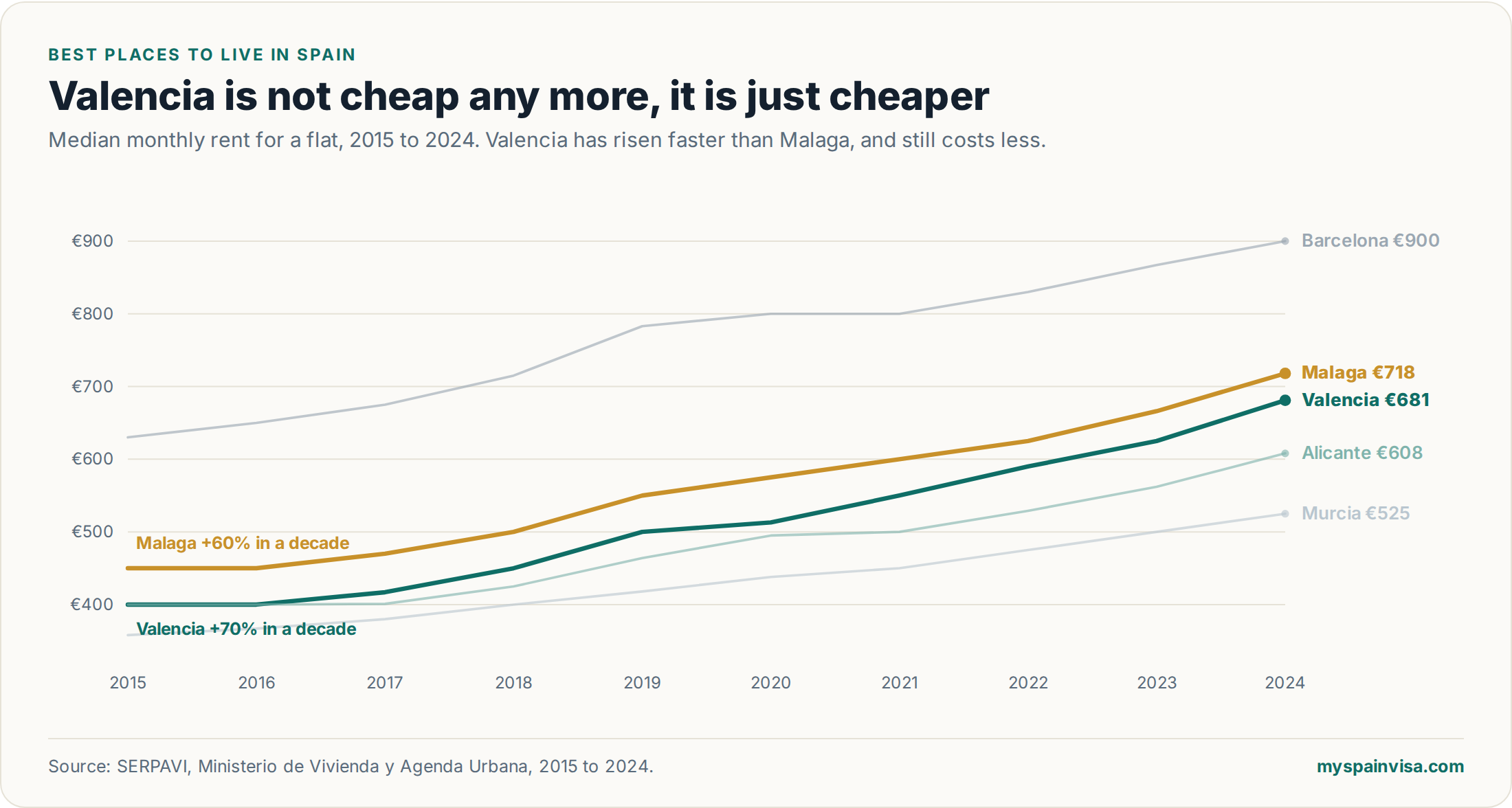
The practical case is straightforward. The 2024 median rent for a flat is 681 euros, against 900 in Barcelona and 869 in Madrid. The old riverbed that runs through the middle of the city was turned into a nine kilometre park after the 1957 flood, so you can cross Valencia on a bike without meeting traffic. The airport connects to most of western Europe. Spanish and Valencian are both official, which matters if you plan to put children into a state school.
What people underestimate is the summer. July and August in Valencia are humid in a way Madrid is not, and the city empties in August. What people overestimate is the language barrier. In the centre and in Ruzafa you will manage in English from day one, although you will not build a life here without Spanish.
Valencia suits you if you are retiring on a fixed income, if you work remotely and want a real city rather than a resort, or if you want to test Spain for a year before committing. It suits you less if you need a large English-speaking job market, which is Madrid, or an international finance and tech scene, which is Barcelona.
Madrid: for English speakers who want jobs and culture
Madrid, the vibrant capital of Spain, is not just a city, it’s a cultural and economic hub that offers an unparalleled quality of life. Known for its world-class nightlife, rich history, and artistic heritage, Madrid is one of the best places to live in Spain, especially for English speakers and expats from around the world.

Why Madrid is a Top Choice for Expats
- Cultural Richness: Madrid is home to some of Europe’s most significant art collections, including masterpieces by Spanish and Latin American artists. Museums like the Prado, Reina Sofía, and Thyssen-Bornemisza make it a paradise for art lovers. The city’s architectural treasures and historical landmarks add to its charm, making it a culturally enriching place to live.
- Affordable Lifestyle: Despite being a major European capital, Madrid offers a cost-effective lifestyle. Whether you’re dining at local tapas bars, enjoying the thriving social scene, or exploring the city’s many attractions, you can do so without straining your finances. While Madrid may not be the cheapest city in Spain, it provides an excellent balance of affordability and quality of life.
- Expat-Friendly Environment: Madrid is one of the best places to live in Spain for expats, offering a welcoming atmosphere and a large international community. For English speakers, the city is particularly appealing, as many locals and businesses are accustomed to interacting with foreigners.
- Vibrant Nightlife and Social Scene: Madrid is famous for its nightlife, with countless bars, clubs, and live music venues that cater to all tastes. The city’s social scene is lively and diverse, making it easy to meet new people and build a social network.
Malaga: for retirees and British expats on the coast

Malaga is a top destination for those looking to retire in Spain or start a new life in the sun. Located on the Costa del Sol, this vibrant city is known for its excellent climate, stunning beaches, and high quality of life, making it one of the best places to live in Spain for English speakers and expats alike.
Why Expats Love Living in Malaga
Malaga stands out for several key reasons:
- Excellent Connectivity: It has Spain’s fourth-busiest airport, providing easy access to international destinations.
- Affordable Living: Compared to cities like London, rental prices in Malaga are up to far lower, making it one of the most cost-effective cities to live in Spain.
- Top-Ranked Expat City: Malaga came first in InterNations’ Expat City Ranking 2023 and second in 2024, reinforcing its reputation as a prime destination for expats in Spain.
- Great Infrastructure: A well-developed public transport network makes getting around effortless.
A Thriving Expat Community
Malaga has a large and active expat population, similar to Alicante, with thousands of British residents choosing to retire, work, or study here. The city’s welcoming atmosphere, combined with affordable property prices, encourages many to buy homes in Malaga and enjoy a relaxed Mediterranean lifestyle.
With its beachfront location, warm climate, and strong expat community, it’s no surprise that Malaga is consistently ranked as one of the best cities to live in Spain. Whether you’re looking for a retirement haven or a fresh start in a sunny paradise, Malaga offers everything you need for an exceptional quality of life.
Alicante: for budget-minded expats who want the beach
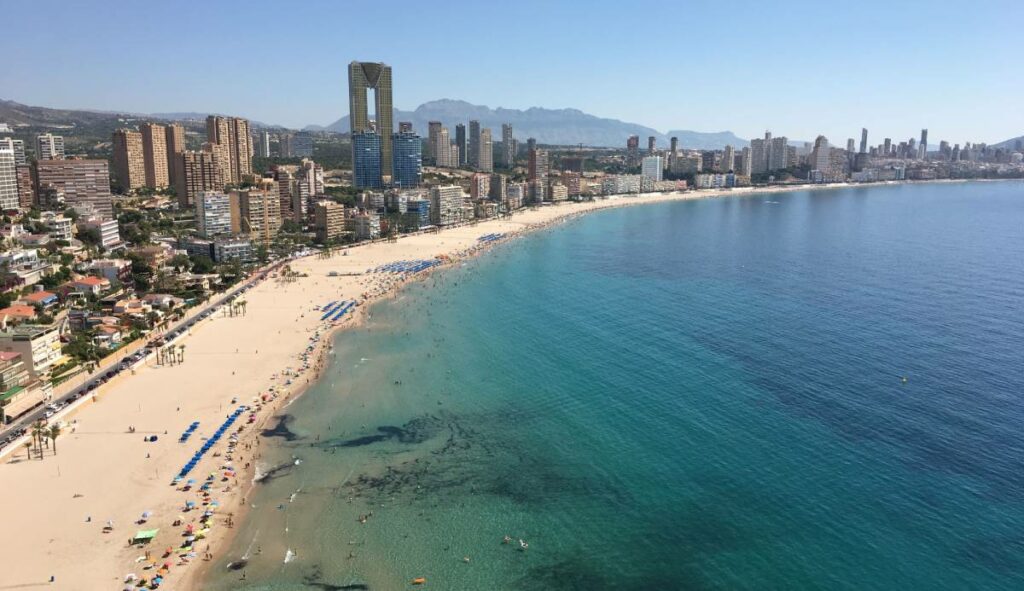
Set on Spain’s sunny south-east coast, Alicante is one of the most sought-after destinations for expats looking to relocate to Spain. With its affordable cost of living, year-round warm climate, and stunning Mediterranean coastline, it’s easy to see why so many British expats and international residents choose to settle here.
Affordable Living in Alicante
One of the biggest advantages of living in Alicante is its affordability compared to other Spanish cities. For example:
- Rental costs in Alicante are far lower than in Barcelona, making it one of the most budget-friendly places to live in Spain.
- Everyday expenses, including food and dining, are significantly cheaper, allowing residents to enjoy a comfortable lifestyle without breaking the bank.
Why Expats Choose Alicante
Alicante is not just affordable; it’s also a vibrant, expat-friendly city with plenty to offer:
- Beautiful Landscapes: From palm-lined streets to pristine sandy beaches, Alicante boasts breathtaking scenery.
- Rich Culture & History: The city is home to historic landmarks, lively markets, and a thriving social scene.
- Large Expat Community: Between 6.5% and 30.5% of residents are expats, proving that Alicante is one of the top destinations in Spain for British expats.
With its perfect blend of affordability, culture, and Mediterranean charm, Alicante continues to rank among the best places to live in Spain for retirees and expats. Whether you’re looking for a cost-effective city to retire in Spain or a new adventure by the sea, Alicante offers an exceptional quality of life.
Seville: for people who want history and Andalusian life
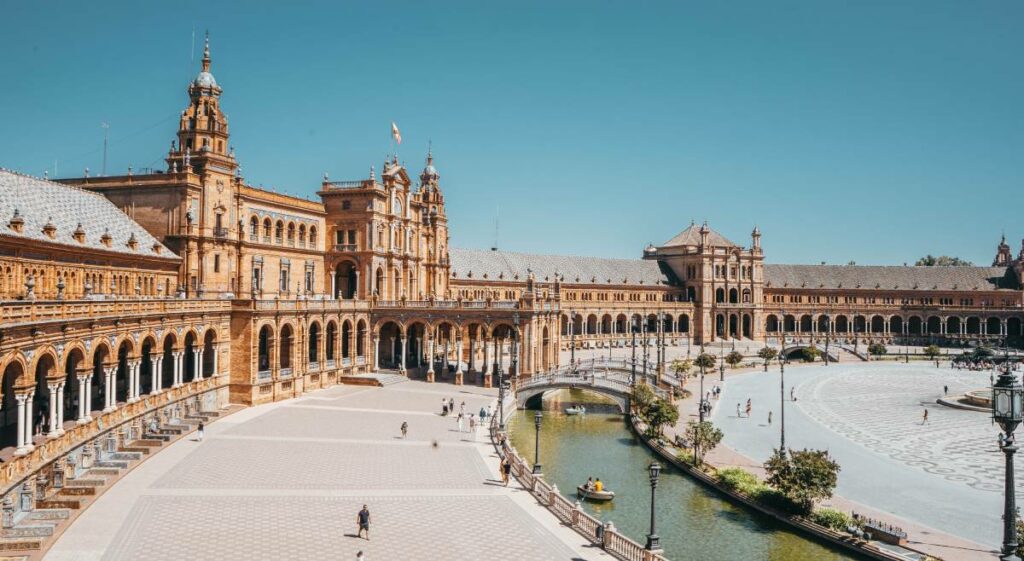
Seville is a city where rich history, stunning Moorish architecture, and a relaxed lifestyle blend seamlessly, making it one of the best places to live in Spain for expats. Unlike the bustling tourist hotspots, Seville offers a charming, laid-back atmosphere, perfect for those seeking an authentic Spanish experience with a lower cost of living.
Why Expats Love Living in Seville
Seville stands out as a top expat destination in Spain for several reasons:
- Perfect Location: Situated near the southern coastline, Seville enjoys warm weather year-round, making it ideal for sun-seekers.
- Walkability & Charm: The historic Old Town and the Triana neighborhood are highly pedestrian-friendly, with narrow streets, boutique shops, and cozy cafés that invite exploration.
- Affordable Cost of Living: Compared to larger cities like Madrid or Barcelona, living in Seville is more budget-friendly, with costs similar to Alicante and Malaga.
- A Safe & Welcoming Environment: While pickpocketing can occur in tourist-heavy areas, violent crime is rare, making Seville a secure and comfortable city for expats.
A City That Offers the Best of Both Worlds
One of Seville’s biggest advantages is its proximity to both beaches and mountains, offering a diverse lifestyle that caters to both outdoor lovers and culture enthusiasts. Whether you’re strolling through the historic Alcázar Palace, enjoying flamenco performances, or relaxing in one of the many sun-drenched plazas, Seville provides a high quality of life for those looking to relocate to Spain.
For expats searching for a vibrant yet affordable place to live in Spain, Seville delivers the perfect mix of culture, history, and Mediterranean charm.
San Sebastian: for food lovers who prefer mild summers
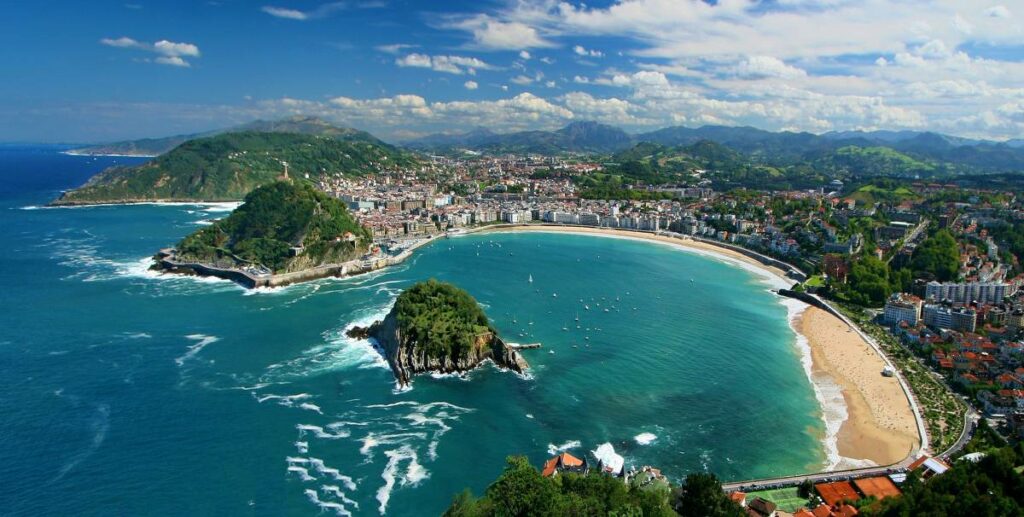
Nestled in Spain’s Gipuzkoa region, San Sebastian is renowned for its exceptional quality of life, making it one of the best places to live in Spain. While it may not offer the sun-drenched climate of the south, this charming coastal city provides a unique and enriching lifestyle that sets it apart from other expat destinations.
Why Expats Love Living in San Sebastian
San Sebastian has earned its nickname as a “Mini Paris”, thanks to its breathtaking architecture, vibrant cultural scene, and rich historical heritage. But there’s more to this city than just its beauty:
- Unmatched Gastronomy: With the highest concentration of bars per square meter in the world, San Sebastian is a paradise for food lovers and those who enjoy tapas, pintxos, and fine dining.
- A More Tranquil Expat Experience: While the expatriate community here may not be as large as in Alicante or Malaga, San Sebastian attracts international residents seeking an authentic, high-quality lifestyle.
- Coastal Beauty & Outdoor Lifestyle: From the stunning La Concha Beach to the scenic hiking trails of Monte Igueldo, the city offers an active, nature-filled lifestyle.
- Cultural & Historical Charm: San Sebastian is steeped in history, with a lively arts scene, music festivals, and a deep-rooted Basque culture that expats find fascinating.
A Sophisticated Yet Welcoming Destination
San Sebastian stands out as a top choice for expats in Spain who prioritize quality of life, cultural experiences, and an elegant European feel. Whether you’re drawn to its Michelin-starred cuisine, its stunning coastal views, or its rich cultural scene, this northern Spanish city provides a distinct, sophisticated alternative to traditional expat hotspots.
For those looking to relocate to Spain, San Sebastian offers a unique lifestyle that blends history, gastronomy, and breathtaking natural beauty, making it a truly special place to call home.
Granada: for students and anyone on a tight budget

Granada is a city that blends rich history, stunning landscapes, and a vibrant student community, making it one of the best places to live in Spain. Home to the world-renowned Alhambra, a UNESCO World Heritage site, Granada offers an immersive cultural experience, allowing residents to explore the remnants of Spain’s Moorish past.
Why Expats and Students Choose to Live in Granada
Granada isn’t just a city for history lovers, it’s also a destination that offers a perfect balance between city life, nature, and affordability:
- Breathtaking Scenery: With the Sierra Nevada mountains to the north and Mediterranean beaches just a short drive south, Granada provides a unique mix of outdoor adventures.
- Affordable Cost of Living: Compared to other major Spanish cities, Granada is one of the most budget-friendly places to live, making it especially attractive for students, young professionals, and expats.
- Lively Student Community: As a university city, Granada has a youthful and energetic atmosphere, filled with bustling tapas bars, cultural events, and a welcoming international community.
Need a Student Visa for Spain? We Can Help!
For international students looking to study in Spain, obtaining a Spanish study visa is essential. Our law firm specializes in visa applications, ensuring a smooth and hassle-free process. Whether you’re applying for a student visa for short-term or long-term studies, we provide expert legal assistance to guide you through every step.
Granada is not just a great place to study, it’s a gateway to experiencing the best of southern Spain. Whether you’re an expat, student, or retiree, this city offers an exceptional quality of life at an affordable price.
Bilbao: for professionals who want work, surf and culture

Bilbao has long been off the radar for many expats, but in recent years, it has emerged as a thriving destination for those seeking a unique Spanish lifestyle. Situated on Spain’s northern Atlantic coast, Bilbao offers a refreshing alternative to the sun-soaked cities of the south, with its distinct culture, stunning landscapes, and growing expat community.
Why Expats Are Choosing to Live in Bilbao
Bilbao is experiencing a transformation, attracting more expats, professionals, and families who want to enjoy a different side of Spain. Here’s why:
- Distinct Climate & Fewer Tourists: Unlike the Mediterranean hotspots, Bilbao offers mild weather, fewer crowds, and a more authentic Spanish experience.
- A Cultural Powerhouse: As the largest city in the Basque Country, Bilbao is rich in heritage, traditions, and gastronomy, adding another layer to Spain’s cultural diversity.
- Strong Economy & Career Opportunities: The Basque region is one of Spain’s most prosperous, making Bilbao a great choice for expats seeking job opportunities and a high standard of living.
- Affordable Living Compared to Madrid & Barcelona: While not the cheapest city in Spain, Bilbao offers a more relaxed lifestyle with lower costs than larger cities like Madrid or Barcelona.
A City That Blends Tradition & Modernity
Bilbao’s industrial history meets modern innovation, creating a dynamic urban landscape. From the iconic Guggenheim Museum to historic shipyards, the city seamlessly merges past and present.
Food lovers will also find Bilbao to be a paradise, with its renowned culinary scene, pintxos bars, and world-class wine selection. Nearby Navarra is known for its booming Rosé wine industry, offering an affordable yet luxurious experience.
Outdoor Adventures & Surfing Hotspots
Bilbao isn’t just about city life, it’s also a gateway to outdoor adventures:
- Premium surfing beaches that remain uncrowded, making it a haven for surfers.
- Scenic medieval towns with historical landmarks, cobbled streets, and picturesque squares, perfect for expats and travelers alike.
Bilbao may not be as well-known as Malaga, Alicante, or Seville, but its growing expat community, strong economy, and cultural richness make it one of the best places to live in Spain for English speakers, professionals, and families.
Zaragoza: for families who want calm and low rents
Zaragoza, the capital of the Aragon region, is one of Spain’s most underrated cities when it comes to expat living. Located strategically between Madrid, Barcelona, Valencia, and Bilbao, this dynamic city offers a high quality of life, affordable living, and a rich cultural heritage, making it an excellent choice for those seeking an alternative to Spain’s more well-known destinations.
Why Expats Choose Zaragoza
- Affordable Cost of Living – Compared to Madrid and Barcelona, rents in Zaragoza are significantly lower, making it a budget-friendly option for expats. The city also offers an excellent public transport system, reducing commuting costs.
- Rich Cultural and Historical Heritage – From the stunning Basilica del Pilar to the Aljafería Palace, Zaragoza boasts a mix of Moorish, Gothic, and Roman architecture, giving the city a unique charm.
- Strong Economy & Career Opportunities – Zaragoza is a key industrial and logistics hub in Spain, home to major companies in automotive, logistics, and manufacturing. Expats looking for job opportunities may find promising prospects here.
- Ideal for Families – With its highly ranked schools, excellent healthcare, and family-friendly neighborhoods, Zaragoza is one of the best cities in Spain for families looking to relocate.
- Climate – Summers are as hot as in Madrid, and winters are cool and windy when the cierzo blows, so it suits people who do not need the sea.
Need a Visa to Move to Zaragoza? We Can Help!
If you’re considering relocating to Zaragoza, our expert immigration lawyers can assist you with obtaining the right visa for Spain, whether it’s a Non-Lucrative Visa, Work Visa, or Student Visa. Contact us today for a consultation and let us guide you through the residency process in Spain.
Ibiza: for remote workers who want island life
Famous for its stunning beaches, world-class nightlife, and exclusive lifestyle, Ibiza is more than just a party island, it’s also one of the best places to live in Spain for expats looking for a relaxed Mediterranean lifestyle. With a growing community of remote workers, digital nomads, and high-net-worth individuals, Ibiza has become a premium relocation destination in Spain.
Why Move to Ibiza?
- A Paradise for Digital Nomads & Entrepreneurs – With its laid-back island atmosphere, excellent coworking spaces, and strong expat community, Ibiza is perfect for remote workers and entrepreneurs looking for an inspiring place to live.
- High-End Real Estate Investment Opportunities – Ibiza is a top choice for property investors, with a booming real estate market that attracts international buyers. Our legal experts can advise property investors on the routes that are still open, now that Spain has closed the golden visa.
- Year-Round Mediterranean Climate – With over 300 sunny days a year, Ibiza offers one of the best climates in Spain, ideal for those who enjoy an outdoor lifestyle, sailing, and water sports.
- A Health & Wellness Hub – Beyond the nightlife, Ibiza has developed into a wellness hotspot, with yoga retreats, organic farms, and a thriving fitness community.
- Well-Connected to Europe – Ibiza’s international airport provides easy access to major European cities, making it a great base for frequent travelers.
Visa Assistance for Moving to Ibiza
If you’re considering moving to Ibiza, whether as a digital nomad, investor, or retiree, our law firm specializes in visa applications. We can help you obtain a Non-Lucrative Visa, Digital Nomad Visa or Work Visa, ensuring a smooth relocation process. Contact us today for expert guidance on how to move to Spain legally.
Best places to live in Spain by profile
The same eleven cities look very different depending on who is moving. This is how we would split them, based on the questions people bring to us.
For English speakers
If you want to get by in English from day one, Malaga and Alicante are the easiest. Both have large British and Irish communities, doctors and estate agents who work in English as standard, and clubs where nobody will expect you to speak Spanish. Madrid is the other choice. Fewer expat enclaves, but more international companies, more international schools and a younger crowd that speaks English at work. Our advice after years of helping people settle is simple: pick the coast if you want English around you every day, and pick Madrid or Barcelona if you want to learn Spanish faster because you have to.
For Americans
Americans tend to choose Madrid, Barcelona or Malaga. Madrid has direct flights to the United States, a large American community and most of the English-speaking jobs. Barcelona attracts remote workers and people in tech, and it is where you will find the widest choice of schools teaching a US curriculum. Malaga wins on climate and cost, and the American community there has grown fast in the last few years. Most Americans we help arrive on the non-lucrative visa or the digital nomad visa. The city you choose does not change which visa you need; your income and how you earn it do.
For UK expats
British expats have settled on the Costa Blanca and the Costa del Sol for decades, so Alicante and Malaga come first. Alicante is cheaper and has direct flights to most UK regional airports. Malaga has a bigger city behind the beach, larger hospitals and a fast train to Madrid. Since Brexit, a new UK arrival is treated like any other non-EU national: a short visit is visa free and anything longer needs a residence visa. We deal with that every week, and the towns that work best for British families have not changed at all.
For jobs and working
Madrid and Barcelona have most of the jobs open to foreigners: multinationals, tech, consulting and teaching English. Bilbao is smaller but pays well in engineering, energy and industry, and Zaragoza is a logistics and manufacturing hub with far lower rents than either capital. One thing to know before you start applying. A job offer on its own does not let you move. Your employer needs to sponsor a work permit, or you need a visa that allows you to work, such as the digital nomad visa if you are employed remotely by a company outside Spain. We handle both routes together with the employer.
With family
Families ask us about schools, hospitals and safe streets, in that order. Madrid and Barcelona have the widest choice of international schools, British, American and bilingual, and the largest children’s hospitals in the country. Zaragoza is the calm option: good state schools, short commutes, low rents and a centre that still feels safe late at night. Alicante works for families who want the beach and a British school within driving distance. Wherever you settle, your children can usually apply at the same time as you, so the family moves together rather than in stages.
For young adults
Madrid and Barcelona are where most people under 30 end up. More jobs, more people passing through, more going on every night of the week. Granada is the student city, with cheap rooms, a free tapa with every drink and the Sierra Nevada an hour away. Seville is the warmer, slower version, with a large Erasmus crowd and a lower cost of living than the two big capitals. If you are coming to study, the student visa is the usual route and it can allow part-time work alongside higher studies. We sort that out from the university admission letter onwards.
For 3 months or a year
For a short stay, pick a city with plenty of furnished rentals and something to do in every season: Madrid, Barcelona, Seville and Malaga all fit. Three months is roughly the limit without a visa for US, UK, Canadian and Australian passport holders. The rule is 90 days in any 180-day period, counted across the whole Schengen area, not just Spain. A year is a different thing. It needs a residence visa or permit, and the right moment to apply depends on the route you take. Ask us before you book the flight, not after you land.
On the mainland vs the islands
Ibiza is the only island on this list, and island life has a price beyond rent: fewer hospitals, fewer flights in winter, and a ferry or a plane for anything the island does not stock. That suits remote workers who travel often and people with a comfortable budget. On the mainland, Malaga and Alicante give you the same sea and sun with a full city behind them, and Barcelona adds a beach to a capital-sized job market. Our rule of thumb: rent on the island for one winter before you buy there.
Near the beach
Malaga and Alicante are beach cities in the classic sense: promenade, sand, mild winters and a town built around the sea. Barcelona has city beaches a short metro ride from the centre, though it is a big city first and a beach town second. San Sebastian has the best urban beach in Spain, La Concha, with Atlantic water, real waves and a cooler climate. Ibiza has the coves. If the beach is the reason you are moving, be honest about winters. The south stays warm. The north turns grey and wet from October to April.
For summer vs winter
Seville, Madrid and Zaragoza get very hot in July and August, and locals leave if they can. Bilbao and San Sebastian are the opposite: comfortable summers, wet winters. Malaga and Alicante are the two cities on this list that stay pleasant all year, which is why retirees pick them. So: if you are only in Spain for the summer, go north. If you are staying for the winter, go south. If you are staying for good, choose the Costa del Sol or the Costa Blanca and put up with the odd hot week.
Not sure which of the eleven fits you?
Answer a few questions about your budget, the climate you want and who is coming with you, and get your own ranking of Spanish towns.
Where should I live in Spain? Take the free quizWhich part of Spain is best to live in?
Spain has a variety of great places to live, depending on your preferences. Malaga, Alicante, and Valencia are perfect for warm climates and beachside living, while Madrid and Barcelona offer a more cosmopolitan experience. Bilbao and San Sebastian are ideal for those looking for a different cultural atmosphere.
Where do most foreigners live in Spain?
Expats tend to live in coastal areas like the Costa del Sol (Malaga, Marbella), Costa Blanca (Alicante, Torrevieja, Javea), Valencia and the Balearic Islands. Cities like Madrid and Barcelona also have large international communities.
What is the safest place to live in Spain?
Spain is a safe country overall. However, San Sebastian, Bilbao, Seville, and Valencia are known for their low crime rates and high quality of life.
What is the best city in Spain for Americans to live in?
Americans often choose Madrid, Barcelona, Malaga, and Valencia, where there are English-speaking communities, job opportunities, and international schools.
Is it cheaper to live in Spain or the USA?
Living in Spain is generally cheaper than in the USA, especially regarding rent, food, and healthcare. For example, rents in Malaga are up to far lower than in London or major US cities.
How difficult is it for a US citizen to move to Spain?
Moving to Spain as a US citizen requires obtaining a visa, such as the Non-Lucrative Visa, Digital Nomad Visa or Student Visa. Our law firm specializes in visa applications, making the process smooth and hassle-free.
Does Spain have free healthcare?
Yes, Spain offers universal healthcare, but expats may need private insurance depending on their visa type. Many foreigners opt for private health insurance to access faster services.
Do you have to pay US taxes if you move to Spain?
Yes, US citizens must file US taxes even if they live in Spain. However, the US-Spain tax treaty can help prevent double taxation. We recommend speaking with our advisors.
What are the best places to live in Spain by the sea?
If you dream of living by the sea, top choices include Malaga, Alicante, Valencia, Barcelona, and the Balearic Islands (Mallorca, Ibiza).
What is the best place to live in Spain for 3 months?
If you’re staying in Spain for a short period, cities like Madrid, Barcelona, Valencia, and Seville offer great experiences with plenty of rental options and cultural attractions. If you’re unsure about visa requirements, contact us for expert legal advice on short-term stays.
What are the best places to live in Spain for young adults?
Young expats often prefer Madrid, Barcelona, Valencia, and Seville, which offer vibrant nightlife, job opportunities, and a diverse international community.
What are the best cities to live in Spain for expats?
The top cities for expats include Malaga, Alicante, Valencia, Madrid, Barcelona, Seville, and Bilbao. These cities offer a mix of affordability, job opportunities, and international communities.
What is the best place to live in Spain with family?
Families looking to move to Spain often choose Madrid, Barcelona, Valencia, or Alicante, as they have excellent schools, healthcare, and family-friendly environments. If you’re moving with your family, we can help you secure the right visa for Spain.
Where is the nicest place in Spain to live?
There is no single answer, and anyone giving you one is guessing. What we can tell you is where demand concentrates. Across our own enquiry records the four most requested places are Barcelona, Madrid, Valencia and Mallorca, and the profile behind each is different. If you want one recommendation that fits the largest number of people, it is Valencia, because it is the only big Spanish city that is affordable, coastal and well connected at once.
Can you live on $1,000 a month in Spain?
In a handful of cities, if you already have healthcare covered, it is tight but possible. The 2024 median rent for a flat is 500 euros in Oviedo, 525 in Murcia and 550 in Zaragoza. In Barcelona, Madrid, Ibiza or San Sebastian it is not realistic. There is a second problem budget articles never mention. If you are not an EU citizen, staying in Spain beyond 90 days in any 180 needs a residence permit, and the non-lucrative residence asks for proof of 2,400 euros a month in sufficient means for the main applicant, from regular income or from savings, plus 600 euros a month for each family member. You can live on 1,000 dollars a month in Murcia. You cannot get the permit that lets you stay there on it.
What salary do I need to live comfortably in Spain?
Start from rent. On 2024 official medians a flat costs 900 euros in Barcelona, 869 in Madrid, 681 in Valencia and 525 in Murcia. A common rule in Spain is that rent should sit near a third of net income, which puts comfortable at roughly 2,700 euros net a month in Barcelona and closer to 1,600 in Murcia. If you are coming on a residence permit rather than a Spanish contract, the government sets the floor that binds: 2,400 euros a month in sufficient means for the non-lucrative residence, plus 600 euros a month per family member, and 2,850 euros a month gross, before tax, for the digital nomad visa. Both thresholds are tied to indicators the government resets, so check the current figure with our advisors before you plan around it.
Thanks for the information! I am thinking of moving to Spain with all my family and I need help with all the paperwork, can you help me?
Juani, sorry this went unanswered properly for so long. Yes, the paperwork is the part we deal with every day. The one thing worth knowing now is that the order surprises people: most routes, including the non-lucrative one, are applied for at the Spanish consulate covering your home address before you move, not once you have arrived. A few permits can be filed from inside Spain while you are here legally, so the first thing we check is which of the two your family falls under. Tell us your nationality and whether you will be working, retired or living on savings, and we can tell you which route fits your family. This is general information rather than advice on your own case, and our advisors can look at your particular situation properly if that would help.
I want to live with my family, we are a British couple with 3 children, what do you recommend? I had thought about Malaga
Aline, our first reply was thinner than your question deserved. For a British family of five, Malaga works, and the international airport genuinely matters when grandparents start visiting. The thing to look at first is schooling. If you want a British curriculum, the Costa del Sol has one of the largest clusters of international schools in Spain, but the fees are a serious annual line in the budget. If your children are going into the Spanish state system, the younger ones will settle fast and a teenager will find it much harder. That balance is why most British families we work with end up in the Malaga to Marbella corridor. It is also worth knowing that the best places to live in Spain for British families and the best places for American ones are not the same list. British families cluster on the coast and the islands, American families in the big mainland cities. Both work, they are just different lives. This is general information rather than advice on your own case, and our advisors can look at your particular situation properly if that would help.
We are interested to spend 6 months in Spain, Malaga.
Sintija, apologies for how long this took. For six months the first thing to sort out is not the flat, it is the permit. Six months is beyond the 90 days in any 180 across the Schengen area that a visitor gets, so a non-EU citizen normally needs to have the permit sorted before travelling rather than after arriving. On Malaga itself, six months is long enough that a normal residential neighbourhood beats the seafront, both on cost and on actually getting to know people. This is general information rather than advice on your own case, and our advisors can look at your particular situation properly if that would help.
Why is Valencia not in the list? I read it is one of the most beautiful and best places to live
Peter, you asked this back in 2022 and we replied at the time that we had to add Valencia. You were right, and it took us far too long to actually do it. Valencia is now in the list, and once we went back through our own enquiry records it went in near the top rather than at the bottom. It is the third most requested city we get asked about, and the most requested of all among people applying for the non-lucrative residence. Thank you for pushing on it.
My husband and I are in our mid seventies. We are interested in spending three months in Spain in warm climate. What places would be good start to begin researching. We would also want to bring our dog. We love good food, culture and a neat place to rent.
Carol, this is very late and we apologise. Some of what follows has changed since you wrote, which is part of why it is worth saying properly. For three months in winter with a dog, the coast around Malaga and Nerja is the standard recommendation and it is a sound one. Two things worth knowing. Spain is unusually relaxed about dogs, and most bars and terraces will let yours sit with you. Getting her here is the paperwork part: an ISO standard microchip, a rabies shot given after the chip and at least 21 days before you fly, and an official animal health certificate, endorsed by USDA APHIS if you are coming from the States or issued by an official vet if you are coming from the UK. And for a three month stay a US or UK passport holder does not need a residence permit, though the 90 days in any 180 is counted across the whole Schengen area and not just Spain, so days in Portugal or France come out of the same allowance. Since April 2026 the Entry/Exit System takes your fingerprints and photo at the border instead of stamping the passport, and officers can still ask for your return flight, where you are staying and proof of funds. ETIAS, the online authorisation, is not running yet but is expected during 2026, so it is worth checking before you book. Within that allowance you can test a place properly before committing to anything. If you want the food and the culture with fewer other visitors, look at Granada or Seville in the winter months. For a stay this length the best place to live in Spain for three months is simply wherever the winter is mildest, because you will be here for the only part of the year when the south is obviously better than the north. This is general information rather than advice on your own case, and our advisors can look at your particular situation properly if that would help.
I have two daughters and i am living in Barcelona but I want to move from Barcelona please help me for my family wich city is best with family benifits
Amir, this reply comes years late and we are sorry. The advice has changed since you asked, so here it is as it stands now. For a family leaving Barcelona the two honest answers are Valencia and Zaragoza. Valencia keeps the coast, the size and the transport, but the median rent is 681 euros a month against 900 in Barcelona, so the same budget stretches a lot further. Zaragoza is cheaper again at 550 a month and calmer, which suits families, though there is no sea. Both have solid state schools. If your daughters are already in the Catalan system, Valencia is the gentler move, because Valencian and Catalan are close enough that they will not start from zero. Among the best places to live in Spain for families, those two come up in our files more than anywhere else, and almost always for the same two reasons: the rent and the school run. This is general information rather than advice on your own case, and our advisors can look at your particular situation properly if that would help.
I gonna take an internship in Spain and I cant decide where to go. Im 25 so im looking for a lively but safe city that also easy to go around and well connected for travel. Do you have suggestions? I have been reading about Andalucia, Valencia and Madrid but I cant decide!
Hi Pat,
Madrid is an amazing cosmopolitan city so if you want to go to a big and exciting place and very Spanish go there. the museums are culture is great. It is cold in winter and very hot in t he summer.
If you are looking for a warmer area with nice beaches Andalucia (this is a region rather than a city) is the place. Flamenco and the idea that foreigners have of us, Spaniards, come from this area.
Valencia is the third biggest city in spain (after Madrid and Barcelona). They have their own valencian language but they also speak Spanish.
I hope this info helps you to decide. Marta
Pat, this went unanswered for far too long and that is on us. For someone your age doing an internship, the two that fit what you described are Valencia and Granada. Valencia is the safer all round bet: big enough to be lively, flat enough to cycle everywhere, on the high speed line to Madrid and with an airport for weekends away. Granada is cheaper and has the liveliest student scene in Andalusia, but it is smaller and less connected. Madrid works too if budget is not your constraint. Seville is wonderful and punishing in August. Of the best places to live in Spain for young adults, Valencia is the one we end up pointing people towards most, and Granada is the one people are happiest about six months later.
I am looking forward to come to Spain. Is Barcelona okay?
Mike, we are answering this a long time after you asked, so take the numbers as today’s rather than as 2022’s. Barcelona is a good choice and it is the city people ask us about more than any other. Two things to know before you commit. It is one of the most expensive cities in mainland Spain, with a median rent around 900 euros a month. And Catalan matters if you are bringing children into the state school system. If neither of those stops you, it is the easiest city in Spain to land in speaking only English. If you are weighing up the best places to live and work in Spain rather than just to live, Madrid has more English speaking roles and Barcelona more international companies, so the answer changes depending on whether you arrive with a job or go looking for one.
Iam looking for a place were to live in Malaga. I am alone, so need a safe area. No car an area were everything is accessible, and a nice building.
Dominique, our earlier reply was too short and you deserved better. For someone living alone without a car, the part of Malaga that works is the centre, around Soho and La Merced. You can walk to everything and the train and metro are close. What we would avoid are the urbanisations up the hill. They photograph beautifully and they leave you dependent on a car for bread. If you want the same walkable setup for less money, the centre of Alicante is built the same way. On safety, the question that matters when you live alone is not the national crime rate, it is whether your street has light and people on it at eleven at night. By that test the centre is the safest part of the city, and the quiet hillside urbanisations are the worst, which is the opposite of what most listings suggest.
Hello and thank you for your article.
We are Canadians (early retired and now self employed)looking to spend a gap year with our two teens, 13 and 17. We are looking at coming Sept 2022 for one year. We are looking at the Almeria-Alicante area, is this a suitable area for teens as well and not just their parents?
Also, will be traveling with our two dogs…are there dog parks, dog friendly areas and in home pet sitters for the times we will want to explore?
Any suggestions/advice would be greatly appreciated.
Thanks so much,
Debbie
Debbie, this is years late and we are sorry for that. Leaving it here anyway, because people write to us with the same plan every month. Almeria is a sound choice for a family year and it is one of the cheapest coastal options in the country, at a 549 euro median rent for a flat on the 2024 official index, against 718 in Malaga. What catches Canadian families out is not the city. A full year is well beyond the 90 days in any 180 that a visitor gets across the Schengen area, so the permit has to be in place before you fly rather than sorted once you land. With a seventeen year old there is a second thing to plan around. Age is assessed when the application goes in, and an adult child is not treated the same as a dependent minor, so the timing of the paperwork and of the first renewal both matter. One more thing for anyone reading this with the same plan. When people ask us for the best places to live in Spain with a family for a single year rather than for good, the answer is usually a mid sized coastal city rather than a village, because a year is not long enough to build a life somewhere with one bus a day. This is general information rather than advice on your own case, and our advisors can look at your particular situation properly if that would help.
Hola mi nombre is Cielito
Me interesa muchísimo localizarme para España,no me gusta mucho el frío y me han dicho que malaga o balboa es muy bueno yo soy retirada y vivo dependiendo de mi pensión.No conozco nada de España y me gustaría que me ayude.Muchas Gracias
Cielito, sentimos muchísimo la tardanza en darle una respuesta de verdad. Si sigue con la idea, lo primero que conviene mirar no es la ciudad sino los ingresos. La residencia no lucrativa, que es la vía que usa la mayoría de jubilados que no son de la Unión Europea, pide acreditar hoy por hoy 2.400 euros al mes de medios suficientes para el solicitante principal, y sirve tanto una pensión como otros ingresos regulares o ahorros que se puedan demostrar. Ese umbral es el mismo en toda España, así que merece la pena comprobarlo antes de enamorarse de una ciudad. Sobre el frío, Málaga funciona, pero Murcia y Alicante dan un clima muy parecido por bastante menos dinero, y las Canarias son lo más templado del país durante todo el año. Esto es información general y no un consejo sobre su caso concreto, y cada situación es distinta. Si quiere, nuestros asesores pueden mirar su situación con calma.