Crypto Taxes in Spain: Guide for Expats in 2026
- 📣 How Spain taxes cryptocurrency in 2026
- ☎️ Capital gains tax brackets 2026
- 👍 Spain Crypto Tax Calculator
- 🔍 How each type of crypto activity is taxed
- 🥇 Form 721: declaring foreign crypto holdings
- 🎧 Wealth Tax and Solidarity Tax on crypto
- ⛔ Does the Beckham Law help crypto holders?
- ⚖️ Moving to Spain with crypto: which visa actually works (and which traps to avoid)
- 👍 DAC8 and MiCA: what changes in 2026
- 👍 How to file your crypto taxes step by step
- ☎️ How to legally reduce your crypto tax in Spain
- 😊 US citizens: FATCA and Spain reporting overlap
- 🌟 UK citizens: post-Brexit dual reporting
- 🌍 Spain vs Portugal vs Cyprus vs Dubai for crypto holders
- 🏆 Case studies (2026)
- ❤️ FAQS Crypto Taxes in Spain
- 🥇 Book a Spain crypto tax consultation
How Spain taxes cryptocurrency in 2026
Every spring I get the same panicked email from US and UK clients who moved to Spain mid-year: “Wait, I owe tax on what?” Spain does not treat cryptocurrency as money. The Agencia Estatal de Administración Tributaria (AEAT, Spain’s tax authority) classifies it as a digital asset, similar to a security or a foreign currency holding. That single classification turns every swap, every staking reward, every airdrop into a reportable event. Here is what that means for you.
As a Spanish tax lawyer who files these returns every spring, three rules dominate what my clients pay:
- You are taxed on disposals, not on holding. Buying Bitcoin and keeping it in a wallet creates no taxable event in Spain. Selling it, swapping it, spending it or earning new tokens does.
- FIFO is the default cost-basis method. When you sell, the Agencia Tributaria assumes you are selling the oldest units first. You cannot pick specific lots.
- Your residency status determines what gets taxed. Spanish tax residents pay tax on worldwide crypto gains. Non-residents only pay on Spanish-source gains.
When does Spain consider you a tax resident?
You are a Spanish tax resident in any of these three scenarios, set out in Article 9 of Ley 35/2006 del IRPF:
- You spend more than 183 days in Spain in a calendar year.
- Your center of economic interest (your main business, your main investments, your main income source) is in Spain.
- Your spouse and dependent minor children live habitually in Spain. This is a rebuttable presumption.
For most people I advise, the 183-day rule is the trigger. If you arrive in Spain on a Non-Lucrative Visa in March and stay through year-end, you cross that threshold and become Spanish tax-resident for the entire calendar year. Your worldwide crypto activity from 1 January onward is reportable here. This is the single most-missed point by US and UK clients arriving mid-year, and the reason I always run a residency-planning session before move-in date. Read more on our Spanish tax residency guide.
Capital gains tax brackets 2026
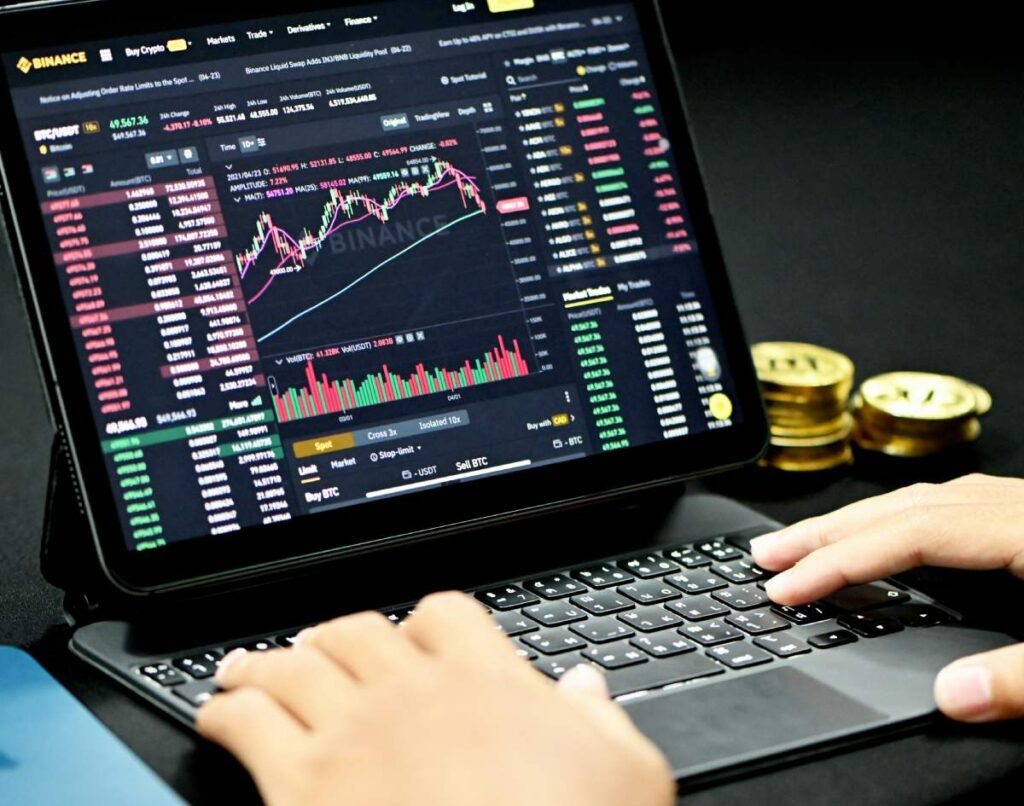
Crypto disposals fall under the savings income base of the Spanish Impuesto sobre la Renta de las Personas Físicas (IRPF), the same bucket as dividends, interest and stock gains. See our full Spain tax guide for expats for the bigger picture. Many English-language guides still publish the old 28% top bracket as their headline figure. That number became outdated on 1 January 2025. The current top bracket is 30%, set by Disposición Final Séptima of Ley 7/2024. The BOE link is right there if you want to check the source yourself.
The current 2026 savings income brackets are:
| Net gain (after losses) | Rate |
|---|---|
| €0 to €6,000 | 19% |
| €6,000 to €50,000 | 21% |
| €50,000 to €200,000 | 23% |
| €200,000 to €300,000 | 27% |
| Above €300,000 | 30% |
Legal basis: Article 66 of Ley 35/2006, as amended by Article 63 of Ley 31/2022 and by Disposición Final Séptima of Ley 7/2024, effective 1 January 2025.
The brackets are progressive. A €250,000 gain is not taxed at a flat 27%. The first €6,000 pays 19%, the next slice pays 21%, and so on. See the full breakdown of Spanish Capital Gains Tax in2026 or use the calculator below to see the effective rate.
Spain Crypto Tax Calculator
Spain Crypto Tax Calculator 2026
Calculate your Spanish IRPF tax on crypto gains in 60 seconds. Results emailed to you and reviewed by a lawyer.
How each type of crypto activity is taxed
The classification of the activity decides whether it lands in the savings base (capped at 30%) or the general base (progressive, with a top rate in 2026 that runs from 45% in Madrid to 53.85% in the Valencian Community, depending on where you live). That gap matters. Here is how I categorize the activities I see weekly.
Buying and holding
No tax. Buying Bitcoin or Ethereum (and the rest of the cryptoasset universe: stablecoins like USDC, layer-1 tokens, governance tokens) and holding it in cold storage or in an exchange wallet creates no taxable event in Spain. The acquisition price is recorded for future cost basis. The only obligation is reporting if foreign-exchange balances cross €50,000, which I explain in the Form 721 section.
Selling crypto for fiat
Capital gain or loss, savings base. Gain equals sale price in euros minus FIFO cost basis. Currency conversion uses the European Central Bank reference rate on the date of disposal.
Crypto-to-crypto swaps
Taxable. Swapping BTC for ETH is treated as a disposal of BTC at fair market value in euros, then an acquisition of ETH at that same value. This is the rule that most US clients underestimate, because the US has a similar approach but enforcement is uneven. Spain enforces it. Every swap is a savings-base event.
Crypto-to-NFT purchases
Taxable as a swap. You are disposing of the crypto used as payment.
Receiving crypto as salary or payment
Employment income (rendimiento del trabajo) in the general base, valued at the euro market price on the day of receipt. The same coin is then held with that euro value as cost basis for any future disposal.
Mining
Economic activity, general base. Miners must register with RETA (the self-employed scheme) and the IAE (business activities census). Mining rewards are revenue, electricity and hardware depreciation are deductible expenses. Read the criteria laid out in DGT binding consultations on this point.
Staking
Movable capital (rendimiento del capital mobiliario), savings base. This is the current consensus position of the Agencia Tributaria. Rewards are taxed at fair market value on the day received. If you later sell, that day becomes your cost basis for the disposal.
Airdrops
General base, taxed as ganancia patrimonial no derivada de transmisión. Valued at market price on the day of receipt. With Spain's general-base top marginal rate at 45% to 53.85% in 2026 (depending on the region), a large airdrop can be one of the most painful events for a crypto-holding resident.
DeFi yield farming
General base, treated as movable capital income or as ganancia depending on the structure. Decentralized finance (DeFi) protocols sit in a regulatory gap that MiCA is only beginning to address. The lack of a unified DGT criterion means most of these have to be analyzed contract-by-contract. I usually ask clients to send me a list of protocols and we classify each.
Liquidity pools
Each LP entry and exit is a swap event, taxable in the savings base on the gain or loss vs FIFO basis. LP rewards are movable capital income.
NFTs: minting versus selling
A non-fungible token (NFT) is treated by Spanish tax law as a distinct asset class from fungible cryptocurrency, but the income classification still follows the same general/savings split. If you are a creator minting NFTs, the income is from economic activity (general base). If you are a collector flipping NFTs, gains are savings-base capital gains. The distinction is intent and frequency.
Form 721: declaring foreign crypto holdings
This is the single rule that catches more US and UK clients off guard than any other. Modelo 721 is a Spanish informative return for crypto held on foreign exchanges or with foreign custodians. It was created by Real Decreto 249/2023 and operationalized by Orden HFP/886/2023.
Who must file: any Spanish tax resident whose aggregate balance of crypto held with non-Spanish providers was above €50,000 on 31 December of the previous tax year. After your first Form 721, you only file again if that total has grown by more than €20,000 since your last filing, or if you stopped holding some of that crypto during the year.
What gets reported: the exchange or custodian, the type of token, the number of units, and the valuation in euros at year end (or at the highest point that triggered the obligation).
When: between 1 January and 31 March of the year following the reporting year. For 2025 holdings, the window is 1 January to 31 March 2026.
Penalties for non-compliance: €20 per missing data item, with a minimum of €300 and a maximum of €20,000, halved if you file late before the Agencia Tributaria contacts you. Incomplete or inaccurate returns are penalised separately. If you are not sure whether you cross the threshold, I tell clients to file anyway.
Form 721 is informative. Filing it does not by itself create a tax liability. But it links your crypto activity to your Agencia file, and from 2026 onward it cross-references automatically with DAC8 data flowing in from EU exchanges. I cover that in section 9.
Filing portal: AEAT sede electrónica.
Need help filing Form 721 by 31 March? Filing late costs at least €150 if you file before the Agencia Tributaria contacts you, and at least €300 if it finds you first. Talk with our lawyers →
Wealth Tax and Solidarity Tax on crypto
Crypto counts toward your Spanish Wealth Tax (Impuesto sobre el Patrimonio) base, valued at fair market price on 31 December. The framework is Ley 19/1991.
State-level Wealth Tax brackets run from 0.2% to 3.5% above the €700,000 individual exemption (plus a €300,000 main-residence exemption that does not apply to crypto). But Wealth Tax is ceded to the autonomous regions, which can rebate it. The regional landscape in 2026 is more nuanced than most guides describe, because the Solidarity Tax (ITSGF) introduced in 2022 partly neutralizes regional rebates for HNW residents:
- Madrid: 100% bonificación on the regional Wealth Tax. Above €3M the state Solidarity Tax (ITSGF) is charged instead, so HNW residents do not end up at zero. See the Solidarity Tax section below.
- Andalucía: same pattern as Madrid. 100% bonificación on the regional Wealth Tax; above €3M, the state Solidarity Tax (ITSGF) applies.
- Galicia: 50% bonificación on the Wealth Tax cuota.
- Catalonia, Asturias, Aragón: standard or above-standard Wealth Tax applies.
- Valencia, Balearic Islands: a much higher tax-free allowance per person. In the Valencian Community it is €2 million for assets held on 31 December 2026 (Valencian Law 13/1997, art. 8), and in the Balearic Islands it is €3 million.
This regional variation, combined with the ITSGF interaction, is one of the biggest planning levers for high-net-worth crypto holders moving to Spain. Use our Wealth Tax calculator to see your projected liability by region.
Impuesto Temporal de Solidaridad sobre las Grandes Fortunas
In 2022 the central government introduced the Solidarity Tax on Great Fortunes via Ley 38/2022. It applies to net worth above €3 million, with brackets of 1.7%, 2.1% and 3.5%. The design is deliberate: it claws back Wealth Tax that regions like Madrid and Andalucía had rebated. If you live in Madrid with a €5M crypto portfolio, you owe zero Wealth Tax but you owe Solidarity Tax. If you live in Catalonia, your Wealth Tax already covers it and you owe nothing additional.
For my UHNW clients with eight-figure crypto positions, this is usually the largest single tax line and the one we plan around first. Regional residency and family structuring matter more than bracket arbitrage here.
Does the Beckham Law help crypto holders?
The honest answer is: it depends on where your crypto sits, and the doctrine has been evolving. I see this question from almost every new US or UK client.
The Beckham regime (Régimen Especial de Trabajadores Desplazados) lets a qualifying inbound worker be taxed broadly as a non-resident for six years. A flat 24% on all employment income up to €600,000, wherever it is earned, and exemption of most foreign-source investment income. The crypto question turns on whether your gains are Spanish-source or foreign-source.
The Dirección General de Tributos has issued a sequence of binding consultations (V1069-19, V1662-23 and V0376-24) that locate cryptocurrency not by where you live but by where the asset is custodied:
- If your crypto sits on a Spanish-registered exchange or with a Spanish custodian, gains on disposal are Spanish-source and fall outside the Beckham foreign-source exemption.
- If your crypto sits on a non-Spanish exchange (Coinbase US, Kraken US, most international platforms) and a non-Spanish custodian holds the keys, gains can be characterized as foreign-source and can fall within the Beckham exemption.
- Self-custody (non-custodial wallet) is the gray zone. V1662-23 added the location of the private key as a relevant criterion. Multi-sig and hot/cold wallet configurations are not yet settled doctrine. I do not advise self-custody clients to bet a Beckham strategy on it without a written DGT consultation specific to their facts.
Practical takeaway for a typical Beckham candidate with crypto on US or non-EU exchanges: Beckham can be meaningful, but it is not automatic. Three things still have to be true. The consultation criteria are met. Your facts are clean enough to defend in inspection. Your structure is documented before move-in. We run that analysis case by case.
We cover Beckham eligibility, application timing and the realistic tax outcomes in detail in our Beckham Law guide.
Want to explore whether Beckham fits your case? The custodian-location analysis is fact-specific and worth a real review. Book a consultation →
Moving to Spain with crypto: which visa actually works (and which traps to avoid)
This is the section nobody else writes, because most crypto tax guides are not written by Spanish immigration lawyers. I deal with both sides every week, so here is the integrated picture.
Can crypto count toward Non-Lucrative Visa financial requirements?
The Non-Lucrative Visa requires you to prove passive income or savings of €28,800 per year for the main applicant plus 25% per dependent. Officially, the consulate wants to see liquid funds, bank statements and a stable income stream.
Pure crypto holdings on an exchange are not the ideal proof. Consulates vary, but in my recent caseload at several US and UK consulates I have seen applications rejected when the only proof of funds was exchange screenshots. The cleaner path I recommend:
- Convert at least 12 months of the required threshold to euros or US dollars before applying.
- Move that amount to a regulated bank account (Spanish, US, or UK).
- Provide 6 to 12 months of bank statements showing the stable balance.
- Include a short cover letter from your accountant explaining the crypto-to-fiat conversion and its tax treatment in your home country.
You can still hold the rest of your portfolio in crypto. The consulate is not asking you to liquidate everything. It is asking for proof of stable means. Read the full requirements on our Non-Lucrative Visa financial requirements 2026 page. I cover one such case in the case-studies section below.
Digital Nomad Visa and crypto income
The Digital Nomad Visa created by Ley 28/2022 requires about €2,850 gross per month in 2026 from employment by a non-Spanish company, or freelance work where at least 80% of the work is for clients outside Spain. Crypto trading as autónomo activity does not qualify. The Agencia Tributaria does not consider proprietary trading "services rendered to foreign clients." If your only income is your own trading, the DNV is not your visa.
The DNV does work for:
- Remote employees of US, UK or Canadian companies who happen to hold crypto.
- Freelance developers, designers and consultants serving non-Spanish clients, where crypto is held but is not the income source.
If you are on the DNV as an employee of a foreign company, you can also opt for the Beckham Law's flat 24% rate, which interacts with crypto in the ways I explained in section 7. Freelancers on the visa generally cannot. Read our Digital Nomad Visa income requirements for crypto holders.
When does the 183-day rule trigger Spanish tax residency on your crypto?
Day 184 of presence in Spain in any calendar year flips you to Spanish tax-resident for the entire year, retroactive to 1 January. This is the most common timing mistake my US clients make. They land in March, casually count the months, and assume only April through December counts. It does not. The entire year is in scope once the trigger pulls. We plan around it on our Spanish tax intake.
DAC8 and MiCA: what changes in 2026
I have a folder of clients regularizing pre-2026 because they know what is coming. Two pieces of EU regulation reshape crypto reporting from 2026 onward, and you should understand both because they remove "the exchange will not tell anyone" as a defense.
Markets in Crypto-Assets Regulation (MiCA), Regulation (EU) 2023/1114 is the unified European Union framework for crypto-asset service providers. It introduces formal definitions for "cryptoasset", "asset-referenced token" (ART) and "e-money token" (the regulatory term for fiat-backed stablecoins). Effective in stages from 2024 and fully applicable since 30 December 2024, with a transition for existing providers that ended on 1 July 2026 at the latest. Any exchange serving EU clients must register, comply with KYC and AML standards, and segregate client funds. The practical consequence for you: every meaningful exchange now knows who you are, has your tax ID, and has a regulatory duty to keep records.
DAC8 (Directive on Administrative Cooperation 8), Directive (EU) 2023/2226 is the automatic information exchange directive for crypto. It extends the OECD's Common Reporting Standard (CRS) model to crypto assets, so the same data plumbing that exposes hidden foreign bank accounts now exposes crypto wallets. EU exchanges report annually to local tax authorities. Those authorities share with the Agencia Tributaria. 2026 is the first reporting period. From 2027 onward the Agencia will receive a yearly file showing exactly which Spanish residents hold which positions on which EU exchanges, at what value, and what they traded during the previous calendar year.
If you have been quietly using EU exchanges and not reporting, 2026 is the year that gap closes. I have spent the past six months running voluntary regularization on cases where clients want to clean up before the Agencia matches the DAC8 file to their existing returns. The penalty for late voluntary regularization is meaningfully lower than the penalty for inspection-triggered correction.
How to file your crypto taxes step by step
- Export your transactions. Download CSV from every exchange and wallet you used. For DeFi and on-chain activity, run a crypto-tax tool (Koinly, CoinTracker or Cryptotax are the three I see most often).
- Convert to euros at ECB reference rates. Every disposal needs a euro value on the disposal date, not the acquisition date.
- Apply FIFO. Spanish law mandates First-In-First-Out for cost basis. Make sure your tool is configured for FIFO, not for the US default of specific identification.
- Aggregate gains and losses. Losses offset gains within the savings base. Excess losses carry forward four years.
- File Modelo 100 (Renta). The annual income tax return. Crypto gains go in the savings base section. The filing window is 1 April to 30 June 2026 for fiscal year 2025.
- File Modelo 721 if applicable. Foreign-exchange balances above €50,000 trigger this separate informative return, due 1 January to 31 March 2026 for the 2025 reporting year.
- File Modelo 714 if applicable. Wealth Tax return, due alongside Renta. Required if your net worth exceeds your regional threshold.
- File Solidarity Tax (Modelo 718) if applicable. Required if your net worth exceeds €3 million after Wealth Tax adjustments.
The filing portal for all four is the AEAT sede electrónica. You need a digital certificate, cl@ve PIN or DNI electrónico to sign returns. I sign every return I review with my MICAP digital certificate.
How to legally reduce your crypto tax in Spain
These are the six levers I actually use in client planning sessions. Skip anything you read online about Spanish "tax-free crypto" tricks. They do not exist anymore. Spain does not have a long-term capital gains discount like Germany's one-year holding exemption either. A gain on Bitcoin you held for ten years is taxed at the same savings-base brackets as a gain on a swap you did last week. The reduction levers are different.
- Loss harvesting before 31 December. Realize losing positions in December to offset gains realized earlier in the year. Spain allows the offset within the savings base for the current year, plus four-year carryforward.
- Time disposals across calendar years. Splitting a €350,000 gain into a €200,000 disposal in Year 1 and a €150,000 disposal in Year 2 keeps you out of the 30% bracket for both.
- Regional residency planning. Where you live on 31 December determines your IRPF region (general base rates vary slightly) and your Wealth Tax bonificación. Madrid and Andalucía remain the most efficient regions for HNW crypto holders, with the caveat that Solidarity Tax bites above €3M.
- Charitable donations. Donations to qualifying entities are deductible at 80% for the first €250 and 40% for amounts above, or 45% for recurring donations (Ley 49/2002), capped at 10% of taxable base.
- Beckham eligibility review. If you are arriving in Spain for employment and your crypto activity is incidental, Beckham can still be valuable for your salary even if it does not shelter crypto. Run the numbers.
- Pre-residency disposal. If you have a large unrealized gain and you are still pre-move, consider disposing in your home jurisdiction before establishing Spanish tax residency. This is timing and treaty-dependent and not appropriate for everyone, but it is the single highest-impact move for the right client.
None of these involve hiding anything. Spain is past the point where opacity is viable. The legal levers are timing, regional choice and pre-move planning.
US citizens: FATCA and Spain reporting overlap
US citizens carry the IRS with them. The Foreign Account Tax Compliance Act (FATCA) is a unilateral US reporting regime that runs in parallel with Spain's domestic rules: the United States is the only major jurisdiction that did not adopt the OECD Common Reporting Standard, so US persons file both sets. Spanish tax residency does not relieve you of US filing obligations. You file:
- IRS Form 1040 annually. Crypto disposals reported on Form 8949 and Schedule D.
- FBAR (FinCEN 114) if your foreign financial accounts (including crypto exchanges) aggregated above $10,000 at any point. Due 15 April with automatic extension to 15 October.
- Form 8938 with your 1040 if your specified foreign financial assets exceeded the threshold ($200,000 single filer abroad on the last day, or $300,000 at any time).
- Spanish Modelo 100, plus Modelo 721 if applicable. Same rules as any other Spanish resident.
The US-Spain tax treaty prevents double taxation through foreign tax credits, but it does not prevent double reporting. You file both. I work with US-Spain cases every month. The two systems do not contradict, but they double the paperwork. Read our Moving to Spain from the US: full annual tax cycle guide for timing tips.
UK citizens: post-Brexit dual reporting
Post-Brexit UK citizens lose freedom of movement but their HMRC obligations follow standard double-tax-treaty mechanics. If you cease UK tax residency (the Statutory Residence Test will determine this) you are out of UK Income Tax and CGT on new disposals, though you may face exit-charge issues on certain assets and you remain liable for UK tax on UK-source income (rental, pensions).
If you are dual-resident in any year, the UK-Spain double tax treaty tie-breakers apply. In my experience the tie-breaker usually lands on Spain once your family and economic center is here.
Practical implications for crypto holders:
- Plan the split year carefully. Brexit-era UK clients moving mid-year sometimes assume HMRC's split-year treatment applies cleanly. Often it does not for crypto, because CGT timing depends on disposal date relative to residency date.
- Crypto held on a UK exchange while Spanish-resident still falls under Spain's Form 721 if above €50,000.
- UK ISA wrappers do not exist in Spain. Disposal of ISA-held crypto after Spanish residency is fully taxable here.
Detail in our Moving to Spain from the UK after Brexit guide.
Spain vs Portugal vs Cyprus vs Dubai for crypto holders
The most common alternatives my clients evaluate. I will not pretend Spain wins on raw tax rate. It does not. Spain wins on EU access, quality of life, healthcare, and infrastructure. Here is the honest comparison.
| Jurisdiction | Crypto capital gains | Wealth Tax | Residency path | Notes |
|---|---|---|---|---|
| Spain | 19% to 30% (savings base) | Yes (regional, up to 3.5%) plus Solidarity Tax 1.7% to 3.5% above €3M | NLV, DNV, Beckham | EU member, top healthcare, Mediterranean quality of life |
| Portugal | 28% flat (short term < 365 days). Long-term gain on tokens held > 365 days currently exempt | No | D7, Tech Visa. NHR ended for new applicants in 2024 | EU member. Without NHR, less differentiated than it was |
| Cyprus | 0% on long-term capital gains for non-business holders | No | Permanent Residence by investment | EU member. Banking and lifestyle compromises for some buyers |
| UAE (Dubai) | 0% personal income or capital gains | No | Golden Visa, Freelance Permit | Non-EU. Climate, distance, lifestyle fit highly individual |
If your single decision driver is "minimize tax on a one-time crypto exit," Dubai or Cyprus are typically cheaper. If your decision drivers include EU residency, family, public services, schooling, and being two hours from London or six from New York, Spain is in your shortlist. Most of my clients self-select for Spain on lifestyle and only ask me to tax-optimize within that choice.
Decided on Spain? Let me plan your tax-efficient move before residency triggers. Book an intake call →
Case studies (2026)
The first case is an illustrative example. The others are anonymized cases from our files: names and identifying details are removed and numbers are rounded.
Example: a US Bitcoin holder applying for the Non-Lucrative Visa
For example, take a US citizen with around $4.2M in Bitcoin on a US exchange who wants to apply for the NLV and plans to show exchange screenshots as proof of funds. Consulates look for bank records, so the file needs restructuring.
In a case like this, part of the holding is moved to a US dollar bank account, with 12 months of statements and a one-page letter from the US CPA explaining the source. On the tax side, a Modelo 721 is due once the crypto held abroad exceeds €50,000, the first Spanish income tax return (Modelo 100) covers the whole year in which you become resident, including any disposal made to fund the move, and the regional analysis has to include the Solidarity Tax (ITSGF), which changes the picture for portfolios above €3M.
Reviewed by Lucia Lagunas Reyes
Q2 2026: London client, UK crypto trader, Beckham denial
A 38-year-old UK citizen, full-time crypto trader, wanted to come to Spain on the Beckham regime to "cap his crypto tax at 24%." That is not how Beckham works.
After analyzing where his crypto was custodied and what fraction would qualify as foreign-source under the DGT custodian-location criteria, we structured around a Digital Nomad Visa, since he had a part-time engagement consulting for a UK fintech that satisfied the DNV income test. The DNV route gave us better predictability than a pure Beckham case in his specific profile, where most of his trading volume sat on Spanish-registered exchanges. His expected gains for the year landed him in the 27% bracket of the savings base. The DNV unlocked Spanish residency cleanly and let us plan disposals across 2026 and 2027.
Reviewed by Lucia Lagunas Reyes
Q1 2026: Texas client, BTC miner relocating to Spain
A 44-year-old US citizen running a small BTC mining operation in Texas wanted to move to Valencia. Mining is economic activity under Spanish law, taxed in the general base, and requires RETA and IAE registration.
We set up the autónomo registration before move-in, structured his electricity and hardware as deductible Spanish business expenses (within reason: he kept the mining hardware in Texas under a US LLC he continued to own, with arm's-length pricing for any transferred output). We also documented the US LLC's substantive economic activity to avoid Spanish CFC inclusion under Article 91 LIRPF (transparencia fiscal internacional). The result was a manageable Spanish tax outcome, US-Spain treaty credits for the US side, and no Form 721 hits because his exchange holdings were below €50,000.
Reviewed by Lucia Lagunas Reyes
FAQS Crypto Taxes in Spain
Do I pay tax on crypto in Spain?
Yes, if you are a Spanish tax resident. Disposals are taxed in the savings base at 19% to 30%. Holding without selling is not taxed. Form 721 reporting may apply if foreign-exchange balances exceeded €50,000.
Is Spain a crypto-friendly country?
Spain is crypto-compliant rather than crypto-friendly. There is a clear legal framework, registered exchanges and full integration with EU MiCA and DAC8. Rates are average for the EU but above zero-tax jurisdictions like UAE or Cyprus.
Which country has the lowest crypto tax?
Among meaningful destinations, the UAE (0%), Cyprus (0% long-term for non-business holders) and El Salvador (0% on Bitcoin gains) are the lowest. Within the EU, Portugal taxes long-term holdings at 0% but its NHR regime closed for new applicants in 2024.
How do crypto millionaires cash out in Spain?
Through regulated MiCA-compliant exchanges (Bit2Me, Kraken, Bitstamp) directly to a Spanish bank, with the disposal reported on Modelo 100 the following spring. There is no informal cash-out path that survives DAC8 cross-referencing.
How can I avoid crypto taxes in Spain legally?
You cannot eliminate them, only reduce them. The levers are loss harvesting, regional residency choice, calendar-year disposal timing, charitable donations and pre-residency planning. Sections 11 and 14 of this guide cover each.
Do I need to declare crypto if I have not sold?
If you are a Spanish tax resident and your crypto held abroad was worth more than €50,000 on 31 December, yes, via Modelo 721. In later years you only file again if the total has grown by more than €20,000 since your last filing. No tax due, but reporting is mandatory.
How does FIFO work for crypto in Spain?
First-In-First-Out. When you sell, Spain assumes you are selling the oldest units you acquired. You cannot pick lots. This raises taxable gain in rising markets compared to specific-identification methods used in the US.
What happens if I do not file Modelo 721?
Penalties are €20 per missing data item, with a minimum of €300 and a maximum of €20,000 per return. The Agencia Tributaria can also flag your file for inspection and look at adjacent obligations (Modelo 100, Modelo 714).
Is crypto-to-crypto taxable in Spain?
Yes. Every swap is a disposal at fair market value in euros, generating a savings-base capital gain or loss.
Are NFTs taxed differently?
For collectors, gains follow the same savings-base rules as crypto. For creators minting NFTs, income is economic activity in the general base.
Are airdrops taxable?
Yes, in the general base at market value on the day received. With general-base top rates of 45% to 53.85% in 2026, depending on the region, large airdrops are painful.
Can my crypto count as proof of funds for a Spain visa?
Indirectly. Consulates prefer liquid funds in regulated bank accounts. The cleaner path is to convert a portion to fiat, hold it in a bank for 6 to 12 months and submit those statements alongside a CPA cover letter. Section 8 covers the playbook.
Does Beckham Law help crypto holders?
It can, depending on where your crypto is custodied. The Dirección General de Tributos (consultations V1069-19, V1662-23, V0376-24) locates crypto by custodian, not by holder residency. Crypto on Spanish exchanges is Spanish-source and outside Beckham. Crypto on foreign exchanges can qualify as foreign-source and benefit from the exemption. Self-custody is a gray area. Plan with a specialist before move-in. Section 7 walks through the doctrine.
Is staking taxed as income or capital gain?
As movable capital income in the savings base, taxed at the same 19% to 30% scale as capital gains. Rewards are valued at market price on the day received, which becomes your cost basis for future disposal.
What if I am a US citizen with crypto and move to Spain?
You file in both jurisdictions. Spain on worldwide income via Modelo 100 plus Modelo 721 if thresholds trigger. The US on worldwide income via Form 1040, FBAR if applicable, and Form 8938 if applicable. The US-Spain treaty prevents double taxation through foreign tax credits. Section 12 covers detail.
What is the deadline for crypto tax filing in Spain?
Modelo 100 (annual income return): 1 April to 30 June for the previous fiscal year. Modelo 721 (foreign crypto holdings): 1 January to 31 March. Modelo 714 (Wealth Tax) filed alongside Modelo 100. Modelo 718 (Solidarity Tax): 1 to 31 July.
Can the Agencia Tributaria track my crypto?
Increasingly yes. MiCA-registered exchanges report under DAC8 from 2026 onward. Spanish exchanges already report. Cold storage and decentralized protocols are harder to track but disposals usually surface on the fiat end.
Does Spain have any tax-free crypto threshold?
No general tax-free threshold for crypto disposals. The savings-base scale starts at 19% from the first euro of gain. The €50,000 threshold for Form 721 is a reporting threshold, not a tax-free threshold.
Book a Spain crypto tax consultation
Legal disclaimer. This guide is informational and reflects Spanish law in force on 2026. It is not personal tax advice. Crypto taxation is fact-specific and depends on residency status, transaction history and regional residence. Before acting, get a written opinion from a qualified Spanish lawyer or asesor fiscal.