Empadronamiento in Spain 2026: Guide & How to Get It
Spain Padrón (Empadronamiento) 2026
- 📜 What is Empadronamiento: Mandatory municipal address register (Padrón).
- 🔑 Essential for: TIE card, public health card, and school enrollment.
- 🏛️ Where: Local Town Hall (Ayuntamiento). Usually by cita previa, online in some cities.
- 📂 Documents: Passport + signed rental contract or property deeds.
For your TIE: police stations ask for the padrón before they issue your residence card. Always ask for the "Certificado", not a simple "Volante".
- 🥇 What is the Empadronamiento (Padrón) Meaning in English?
- ⚠️ Why Do You Need an Empadronamiento in Spain? (Main Benefits)
- ❤️ Empadronamiento Spain Requirements: What Documents Do You Need?
- ⏰ How to Get Empadronamiento in Spain: City-by-City Guide
- ⏰ Certificado de Empadronamiento vs. Volante: What’s the Difference?
- ☎️ Renewing Your Padrón: Spain Padrón New Rules
- 🌍 FAQs About Empadronamiento in Spain in 2026
Moving to Spain is an incredible adventure, but the reality of Spanish bureaucracy can hit you like a ton of bricks. If you are planning your move, there is one mandatory step that sits at the very top of your checklist: getting your Empadronamiento (commonly known as the Padrón).
This official municipal register is the key to your new life in Spain. It is strictly required for essential steps like picking up your physical residency card (TIE) or registering for public healthcare. Without your padrón certificate, your legal arrival process will come to a halt.
Navigating the local Ayuntamiento (Town Hall) requirements doesn’t have to be a headache. At My Spain Visa, our team of expert immigration lawyers, led by our co-founder and specialist Lucía Lagunas Reyes, who has practised immigration law since 2012, has helped thousands of expats cut through the red tape.
In this updated 2026 guide, we break down exactly what the empadronamiento is, the documents you need, and how to get it done without the stress.
💡 Expert Tip from Lucía Lagunas: “Many of our clients arrive thinking the hard part is over once their visa is approved. If you are moving here on a Non-Lucrative Visa, remember that getting your empadronamiento is the absolute first mandatory step you must take within 30 days of arriving to secure your physical residency card. Don’t leave it for the last minute!
What is the Empadronamiento (Padrón) Meaning in English?
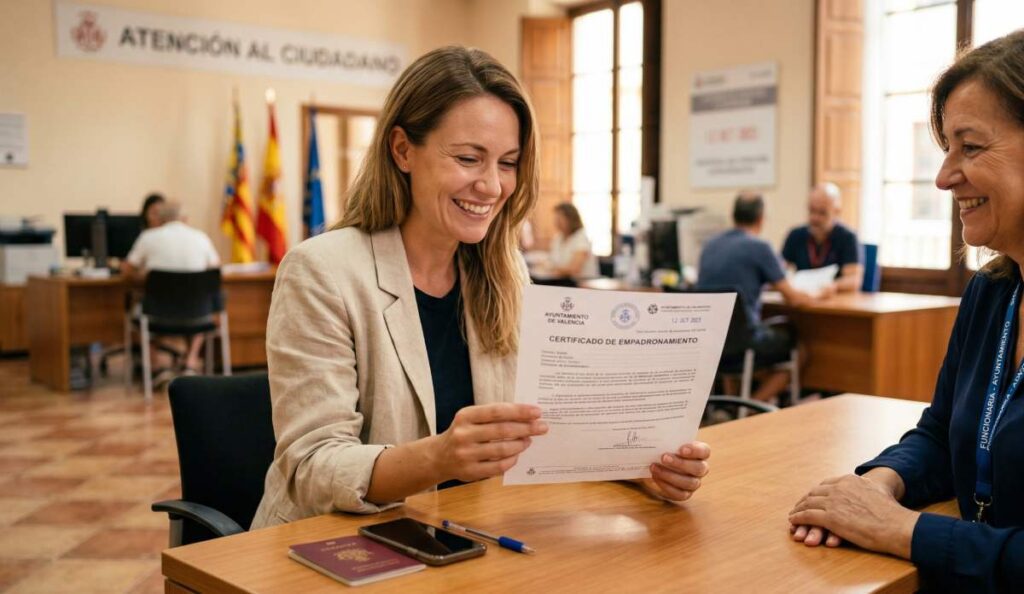
If you are trying to navigate Spanish bureaucracy, the terminology alone can be a challenge. So, what is empadronamiento exactly?
In simple terms, the empadronamiento meaning in English translates to the “municipal register of inhabitants” or a “certificate of census registration.” It is the official administrative record kept by your local Town Hall (Ayuntamiento) that proves exactly where you live in Spain and who you are living with.
You will often hear locals refer to it simply as the Padrón. If you are wondering what is padrón in Spain, it is essentially the database itself. When you complete the registration process, you become officially empadronado (registered).
By law, everyone who lives in Spain, whether you are a Spanish national, an EU citizen, or a non-EU expat, is required to register on the padrón of the municipality where they usually live.
Why Do You Need an Empadronamiento in Spain? (Main Benefits)
You might be thinking: “Do I really need to do this?” The short answer is yes. Getting this certificate is not just a formality; it is the master key that unlocks your daily life and legal status in the country.
Without it, you simply will not be able to complete most of your essential administrative tasks. Here is exactly why you need it:
- To Obtain Your Legal Documents: It is the usual proof of your address in Spain. The police ask for it when you change the address on your TIE Card (foreigner identity card), and it is the standard way to show how long you have lived here when a permit depends on it, such as arraigo.
- To Access Public Healthcare: You will need your certificate to register with your local health center (Centro de Salud) and apply for your public health card. If you are navigating your medical options, you can read more in our complete guide to Healthcare in Spain for Expats.
- To Enroll Children in School: Public and semi-private (concertado) schools require proof of address to assign your child a spot based on your school district.
- To Buy a Car or Get a Driver’s License: You must prove you are a resident of the municipality where you are registering the vehicle.
- To Get Married in Spain: The civil registry requires proof of your address for the marriage file.
⚠️ Legal Note: While registering on the padrón is an obligation for everyone living in Spain, it does not grant you legal residency. Having an empadronamiento proves where you live, but you still need an approved visa or residency permit to prove your legal right to live in the country.
Digital Nomad Visa & Empadronamiento: Special 2026 Rules
A common question for remote workers is whether they need to register immediately. Under the 2026 immigration guidelines, there is a key distinction:
- The Application Stage: You can usually apply for the Digital Nomad Visa (either at the Consulate or via the UGE in Spain) without being empadronado yet.
- The TIE Card Stage: Once your visa is approved, getting your physical residency card (TIE) is 100% impossible without a Certificado de Empadronamiento.
Our advice: Even if you are staying in a temporary rental or Airbnb initially, you must secure a long-term address and register at the Ayuntamiento as soon as possible to avoid delays in your final residency step.
Still deciding which town to register in?
Your padrón goes where you actually live, so pick the town first. Our where should I live in Spain quiz weighs your budget against the climate, healthcare and flights you want, and ranks your top 15 towns.
Find my top 15Empadronamiento Spain Requirements: What Documents Do You Need?
There is nothing more frustrating than waiting weeks for a Town Hall appointment in a new country, only to be turned away because you are missing a single photocopy. To make sure your registration is approved on the very first try, you need to come prepared.
If you are wondering que necesito para empadronarme (what do I need to register?), here is the exact list of empadronamiento Spain requirements you must bring to your appointment:
- Valid Identification: You must bring your original, valid passport, along with a photocopy of the main photo page. If you are an EU citizen, your national ID card is also accepted.
- The Application Form: You will need the official Solicitud de Empadronamiento form, fully completed and signed by all adults registering at the address. You can usually download this directly from your local Town Hall’s website.
- Proof of Residency in Spanish: You must prove that you legally occupy the address. If you own the property, bring your original property deeds (escrituras). If you are renting an apartment, bring your original signed rental contract and a recent utility bill to back it up.
- Family Documents (If Applicable): If you are registering with your spouse or children, bring your Family Book (Libro de Familia) or your officially translated and apostilled marriage and birth certificates, plus the passports of all family members.
💡 Renting a room or living with flatmates? If your name is not on the main rental contract, you can still register! You will need a signed authorization letter from the landlord or the main tenant who is already registered there. You must also bring a signed photocopy of their ID or passport to prove they have authorized you to use the address.
How to Get Empadronamiento in Spain: City-by-City Guide
Let’s be completely honest for a second: in Spain, every single city, town, and village runs its own Town Hall (Ayuntamiento). This means the exact steps to register can literally change from one street to the next if you cross a municipal border. Yes, it’s exactly as chaotic as it sounds.
But don’t panic. If you are trying to figure out how to get empadronamiento in Spain, the general rule is always the same: you either need a digital certificate to do it online, or you need to book a cita previa (prior appointment) to go in person.
To save you hours of clicking around confusing government websites, we’ve tracked down the exact official links for the most popular expat destinations.
How to get Empadronamiento in Barcelona (Online & In-Person)
Barcelona is efficient if you are tech-savvy. If you have a Spanish Digital Certificate (idCAT), you can get your Barcelona Padrón online instantly. If you don’t, you must book an OAC appointment. Getting a slot can feel like winning the lottery, so check the website very early. Tip: Try searching for offices in districts like Nou Barris or Horta-Guinardó; they often have more availability than the central offices in Ciutat Vella.
- Official Link: Ajuntament de Barcelona Registration
- Need local help? Reach out to our Immigration Lawyers in Barcelona.
How to get Empadronamiento in Madrid
In the capital, showing up without an appointment will result in being turned away. To get your Madrid Padrón, you must book a cita previa at your local OAC (Oficina de Atención a la Ciudadanía). You can do this via their portal or by calling 010. Tip: New slots are usually released at 09:00 AM sharp, Monday to Friday. If the web is full, call 010 early as they sometimes have last-minute cancellations not shown online.
- Official Link: Sede Electrónica Madrid Registration
How to get Empadronamiento in Valencia
Valencia has upgraded its digital systems, but many expats still prefer going in person to ensure their Certificado is stamped correctly. The key to the Valencia Padrón is a flawless rental contract: the city asks for a lease of more than six months, and month-to-month renewals do not count. Tip: If the main office on Calle Periodista Azzati is collapsed, check the peripheral “Juntas de Distrito” for faster appointment availability.
- Official Link: Sede Electrónica Valencia Registration
- Need local help? Talk to our Immigration Lawyers in Valencia.
How to get Empadronamiento in Málaga
The Costa del Sol is beautiful, but the bureaucracy is very real. Málaga has a dedicated portal for population registry matters. Tip: You must book your appointment at the specific district office that corresponds to your postcode (código postal). If you show up at the wrong district, they will refuse to process your application on the spot.
- Official Link: Sede Electrónica Málaga Registration
How to get Empadronamiento in Sevilla
Sevilla requires you to use their specific platform to get the ball rolling. While the process is straightforward, the website is notoriously clunky on mobile browsers. Tip: Always use a desktop computer to book your appointment. If no slots are available online, calling 010 from a Spanish phone number often reveals “hidden” gaps in the schedule that don’t appear on the web.
- Official Link: Ayuntamiento de Sevilla Registration
🎯 Moving to a different Spanish city? > Every single municipality in Spain has its own unique rules, forms, and appointment systems. If your new home isn’t on this list, maybe you are heading to Alicante, Bilbao, or a quiet coastal town, don’t worry! Contact our team at My Spain Visa, and we will guide you step-by-step through your specific local Town Hall process.
Certificado de Empadronamiento vs. Volante: What’s the Difference?
Let’s clear up a classic rookie mistake that breaks our hearts every time we see it. Imagine this: you wait months for your immigration appointment, you proudly hand over your paperwork, and the police officer rejects your application on the spot. Why? Because you brought a volante instead of a certificado.
Yes, they are different, and the local officials will not let it slide.
- Volante de empadronamiento in English: Think of this as a quick, informative printout. It’s perfectly fine for everyday tasks like registering at the local health clinic, getting a library card, or proving your address to a school. But it has no legal weight for immigration.
- Certificado de empadronamiento in English: This is the heavy-duty legal document. It comes with a physical signature, a stamp from the Town Hall, or a secure digital verification code. You absolutely must request the empadronamiento certificate for visas, residency cards, and civil registry matters (like getting married).
Pro Tip: When you sit down at the Town Hall, explicitly say: “Necesito un certificado para Extranjería” (I need a certificate for Immigration). Don’t let them just hand you a volante to get you out the door quickly.
Renewing Your Padrón: Spain Padrón New Rules
A lot of expats think registering is a “one-and-done” deal. It’s not. If you ignore the Spain padrón new rules, the Town Hall will eventually assume you left the country and quietly delete you from the system. Finding out you are “unregistered” exactly when you need to renew your visa is a nightmare you want to avoid.
Here is exactly when you need to renew:
- Non-EU Citizens (with temporary residency): You must renew your registration every 2 years.
- EU Citizens & Permanent Residents: You must confirm your residency every 5 years.
If you are wondering how to check padrón online to see if yours has expired, most major Town Halls allow you to log into their digital portals using your Spanish Digital Certificate or Cl@ve to check your current status. But honestly? The easiest way is to just set a calendar reminder on your phone the day you get your first certificate.
FAQs About Empadronamiento in Spain in 2026
How much does empadronamiento cost in Spain?
Registering on the padrón is completely free. However, some Town Halls may charge a tiny administrative fee (usually between €1 and €3) if you request the official printed and stamped Certificado. The Volante is almost always free.
Can I get an NIE without an empadronamiento?
It depends on the type of NIE. If you are applying for a “non-resident NIE” (just the tax number to buy a house or a car), you usually do not need to be registered. However, if you are applying for your TIE (the physical resident card), the empadronamiento is 100% mandatory.
Is empadronamiento the same as residency?
Absolutely not. This is a huge misconception. The padrón simply proves where you are living geographically. It does not grant you the legal right to live, work, or stay in Spain. You still need an approved visa or residency permit for that.
What is padrón in Spain for tourists?
Nothing. Tourists should not register on the padrón. It is only for people who actually live in the town, not for visitors. If you are only visiting for up to 90 days, you do not need an empadronamiento.
Moving to Spain should be about enjoying tapas in the sun, exploring your new neighborhood, and starting a fresh chapter, not about crying over broken government websites, struggling with the language barrier, or worrying if you checked the right box on a confusing form.
At My Spain Visa, we don’t just give you advice; we take the weight off your shoulders. Led by our top immigration expert, Lucía Lagunas Reyes, our English-speaking legal team has helped thousands of expats secure their visas, TIE cards, and local registrations without the headache.
Why risk delays or rejections? Whether you need help booking that impossible Town Hall appointment, securing your passive income visa, or just want a professional to hold your hand through the entire Spanish immigration maze, we are here for you.
Don’t let the paperwork ruin your Spanish dream. Let’s get this sorted out fast. Click below to reach out to our team, and we will get back to you with a clear action plan.
I want to obtain the certificate de empadronamiento in Valencia, can you help me?
One of our lawyers will help you to obtain the certificado de emprandonamiento
He comprado una vivienda en Granada pero sin poder aprovechar de la visa dorada. Tengo que verificar la mejor manera de obtener la residencia espanola.
Uno de nuestros abogados se pondrá en contacto con usted para ayudarle en el proceso.
Padrons are supposed to be max. 90 days old.
What if the ayuntamiento are taking more than 90 days to process emapadronamientos?
My ayuntamiento in Telde can’t even give me an appointment within 90 days of moving here, much less process it in that time.
Is this one of those laws where certain things are “supposed” to happen but they don’t and there’s no accountability?
Simon,
One of our lawyers will contact you to answer your questions about Certificado de Empadronamiento.
Regards,
Pls am a tourism who wish to start a life in spain can i register for empadronamiento before me visa expires
Opoku,
One of our lawyers will contact you to answer your questions about empadronamiento.
Regards,
Hi
My partner and i will be moving to spain with a non lucrative visa. We were planning on inspecting rental properties while we are over there and staying in an air bnb while we find the right place. Is there any way we can get our empadroniamento before we rent, by providing details of the air bnb perhaps?
Thanks,
Elsie
Elsie,
One of our lawyers will contact you to answer your questions about the certificado de empadronamiento.
Regards
Please contact me for my questions
Billie,
One of our lawyers will contact you to answer your questions about certificado de empadronamiento.
Regards,